The Dr Says….


We live in a harsh world. We live in a dog eat dog world where we turn a blind eye to the hungry, homeless, needy and dying.  I have had the most unfortunate experience of living through my daughter’s inextricably slow death.

Many times I would lie next to her in her bed, and wonder how much fear she was experiencing.  She expressed her fear for the boys, her dad and me.  Never did she talk about her fears for herself.

That I read in the blog of an incredible woman, Sandra Callahan.  Sandra suffers from congestive heart failure.  She is living with her impending death.  This brave woman’s journey gave me insight into my child’s heart and mind.  I am eternally grateful to Sandra for her blog, her raw honesty, her friendship and advice.  Sandra selflessly shares her journey with the world.

I have benefitted from her blog.  Vic benefitted from her blog.  Many people have and will benefit from her journey in the years to come…Sandra has externalized her journey by publishing a book.

I was so honoured when her agent asked me to write a review.  Yet it was a difficult review to write.  How do you say you derived “pleasure” from something as heart-breaking as Sandra book?   How do I thank Sandra for telling me what it feels like to die?  How do I thank her for allowing me to understand my dying daughter’s heart?

Sandra, my friend, thank you for your advice over the past two years.  I carry you in my heart and wish we could have met…

I urge you to buy Sandra’s book.  It is an amazing read.  Read about the beautiful, albeit failing heart, of one of the bravest people you will ever encounter.  Click on this link http://www.amazon.com/The-Dr-Says-Sandra-Callahan-ebook/dp/B00GCB2TS2/ and you will be one step closer to understanding the brave heart of a dying woman.

The dr says

http://thedrsays.org/the-dr-says-read-this-book/

A mother’s loss…


“No one loses a child the way a mother loses one. We are the ones who first felt life, carried it and protected them, nourished them, sacrificed our bodies for them, held them first in our hearts, then first into our arms. We were not only connected through flesh, but on levels so deep, you really have nothing to compare it too metaphysically.

It is a love so raw, and so elemental that is just present – just there from the beginning. We have a link to our children that cannot be replicated. No one understands a grieving mother except for another grieving mother. No one else can begin to understand that void that surrounds us, shadows us, haunts us. Our children’s screams that we can no longer answer, their bodies we can no longer grab and embrace, their tears we can no longer dry, and their hurts that we can no longer make better. They then become our own unanswered screams, our bodies that become un-embraceable, our tears that can never be dried and our hurts that never stop. There are constant reminders of what we live without, and must live without until we die – sometimes it feels like it’s life’s cruel way of taunting us. The grieving mother is never whole again, never fully present, because a piece of her heart and soul leave her with her child’s last breath.”

https://www.facebook.com/WingsofHopeLivingForward

May God have mercy on us…

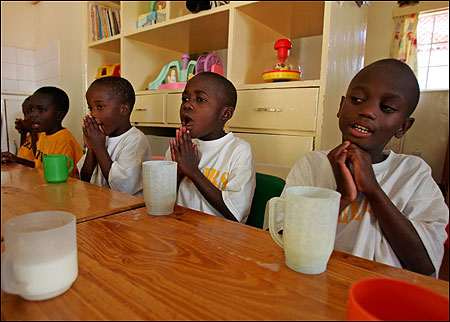
To God


“To God, I hope you look after Auntie Vicky. She is very sick. Love Chloe Alexa Burger” My precious 5 year old UK granddaughter wrote this…her mommy found it in her school satchel last week.

To God

Dear God, hear the words of a five-year old.

Stepping Stone Hospice


This week I truly realised that the Stepping Stone Hospice patients are “our” people. Our friends. They are not strangers. They are people we know from church, they are our neighbours, our friends; friends of friends… Our Hospice cares for our own. We are not “removed” from the community.

We however continually grieve.

Stepping Stone Hospice is just so different. We are not a group of detached, paid staff doing a job. This is a Hospice driven by the tears of its members. It understands the fear in the hearts of its dying and its survivors. We see our loved ones

We have lost our fear of death. We have not become immune to the tears of our community and friends. We truly live and experience “Ubuntu” every day.

A little old lady has shuffled into our offices with R150.00 ($15.00). She told us that when the interest rate went up she would be in a position to increase her monthly contribution to our “worthy cause”. How amazing would it be if everyone in our community contributed $15.00 a month?

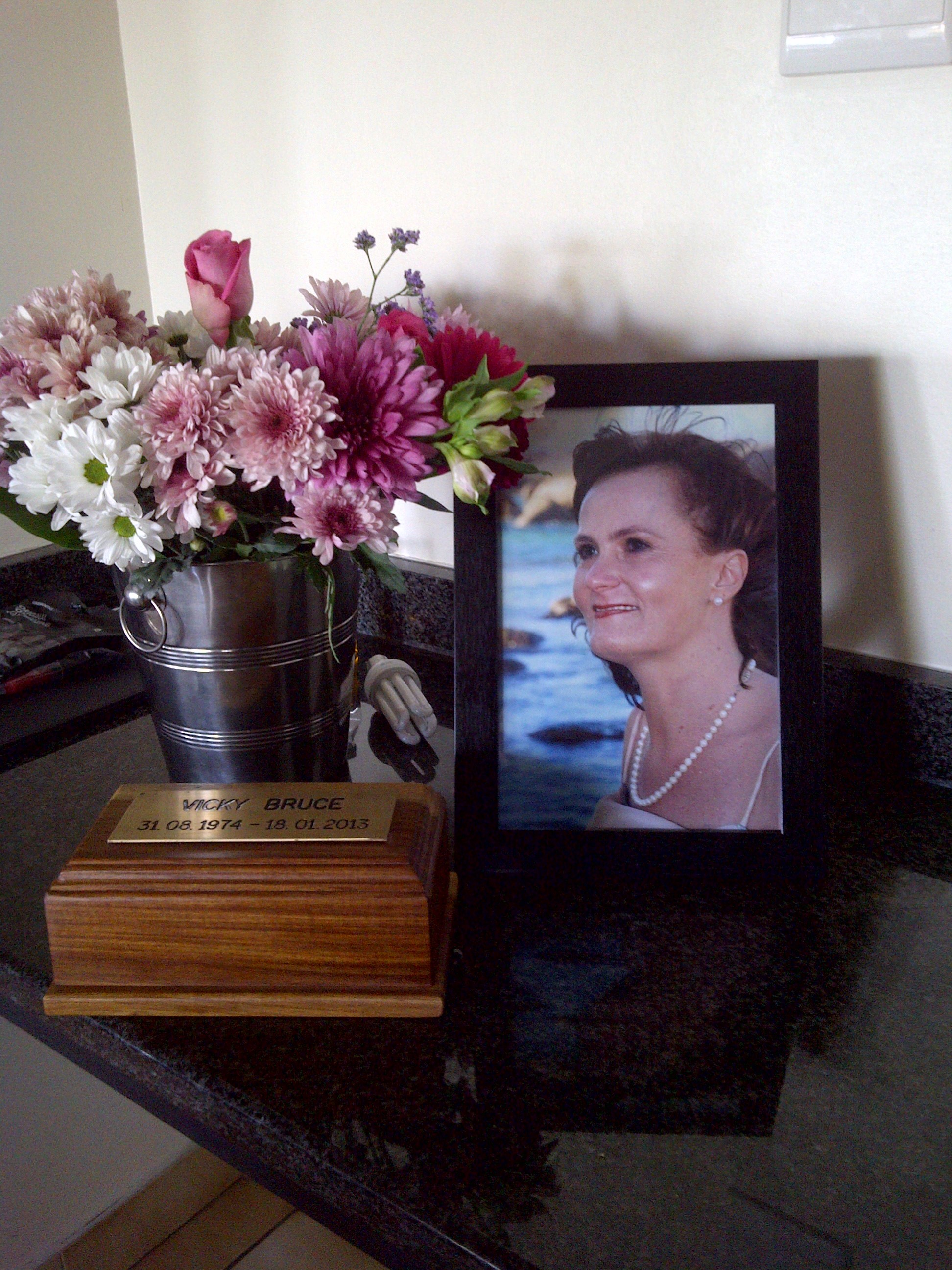
I love spending time in our building. I feel close to Vic.

Our Hospice journey is a healing journey. We have been helped over the stepping stones…now it is our turn to take the hand of another and help them over the stepping stones. What an amazing privilege. All built upon our own tears and the deaths of our loved ones.

Together We Walk the Stepping Stones
by Barb Williams

Come, take my hand, the road is long.
We must travel by stepping stones.
No, you’re not alone. I’ve been there.
Don’t fear the darkness. I’ll be with you.

We must take one step at a time.
But remember, we may have to stop awhile.
It’s a long way to the other side
And there are many obstacles.

We have many stones to cross.
Some are bigger than others.
Shock, denial, and anger to start.
Then comes guilt, despair, and loneliness.

It’s a hard road to travel, but it must be done.
It’s the only way to reach the other side.

Come, slip your hand in mind.
What? Oh, yes, it’s strong.
I’ve held so many hands like yours.
Yes, mine was once small and weak like yours.

Once, you see, I had to take someone’s hand
In order to take the first step.
Oops! You’ve stumbled. Go ahead and cry.
Don’t be ashamed. I understand.

Let’s wait here awhile so that you can get your breath.
When you’re stronger, we’ll go on, one step at a time.
There’s no need to hurry.

Say, it’s nice to hear you laugh.
Yes, I agree, the memories you shared are good.
Look, we’re halfway there now.

I can see the other side.
It looks so warm and sunny.
On, have you noticed? We’re nearing the last stone
And you’re standing alone.
And look, your hand, you’ve let go of mine.
We’ve reached the other side.

But wait, look back, someone is standing there.
They are alone and want to cross the stepping stones.
I’d better go. They need my help.
What? Are you sure?
Why, yes, go ahead. I’ll wait.

You know the way.
You’ve been there.
Yes, I agree. It’s your turn, my friend . . .
To help someone else cross the stepping stones.


Fridays


Compensation-20130629-02085I woke up on yesterday morning with my hair wet from my tears. It was Friday again. For the past 41 weeks I have woken with my heart shattered. I dread Fridays. It is not a conscious decision to wake up crying. I don’t go to bed thinking that “tomorrow it is X number of weeks…” It is as if my body has an automatic alarm that alerts my tear ducts, my heart, my being. When I open my eyes there is a voice screaming “It’s Friday. Week Number …”

It has been an eventful and strangely emotional week.

On Wednesday evening we attended my youngest grandson’s concert. Not only was he the best actor but he noticed his gran in the audience and waved back! I sat there and realised that my precious child would never attend another school concert; she would never attend her grandchildren’s’ concerts ever. I realised that I would more than likely never attend the UK girls’ school concerts ever.

The boys started writing exams. I know how stressed Vic would have been about these particular exams. Jared’s year mark will determine whether he can apply for university entrance for the year 2015. The poor child was off to a rough start in the beginning of the year.

On Friday a 37-year-old woman dropped dead in the shopping mall.

On Saturday a beautiful young woman who calls me her “back-up” mom and her precious daughter shared a birthday. Laughter and joy reverberated through their home. A beautiful “Monster High” cake baked by a wonderful mother… Something that Vic will never get to do again.

I have nightmares of Vic being ill and me not being able to get to her…Desperation and fears permeates my dreams. I wake up in blind fear.

Will my heart ever heal? I read that life takes on a “new normal”…I just want my old life back.  I want my child back.

I don’t want to forget


I don’t know whether I ever posted this.  I know that I was desperate to remember everything.  Today I know I did not write enough, I did not take enough photos, I did not spend enough time talking to my child.

So I don’t forget…

Lucinda commented today “Again, I can’t add anything on to what others have said; I don’t know how you have the courage to make these posts.”

I sometimes wonder why do I blog?  My whole being screams “so I won’t forget”.  I want to remember every day, every spoken word, every unspoken word, every feverish touch.  My friends have lifetimes ahead with their children…I don’t.  They have many more Christmases and birthdays to look forward to.  The chances are that their children will bury them… As a family we lived one day at a time.  We were grateful for every morning when we wake up!

We have friends who lost their 17 year old son almost 17 years ago.  I have not seen her in a couple of years.  When I last saw her she said that it does not become easier with time.  One just learns to cope with the pain and the loss.  My friend had to walk away from her son.  He was declared brain dead after a drunk driver drove into the car transporting him to a rugby match….

She said “I touched his big feet.  I lay my head on his chest and I could hear his heart beat …. I walked away and his body was warm…”  Steven’s heart beats on in another person’s chest.  They, generously in all their pain, donated his organs and saved the life of another mother’s child..

Joan never had the opportunity to say “goodbye forever” to Steven.  She said “Goodbye, have a good game.  Love you!”  Joan treasures the last hug, kiss, laugh… She holds onto it.

I want to hold onto every memory I possibly can.  As hard as it is, I write so I will remember everything. 

A lot of what I write I don’t post.  It is too raw.

I hold onto Vic’s last words to me…”I love you Mommy”.  I hold onto the memory of her beautiful smile, her brave battle, her devotion to her sons and family.  I hold onto the purity of her heart and the kindness in her heart.  I hold onto her gentle memories.

Never has the pain been as raw and the loss as real as now.  For a couple of weeks I arrogantly thought that a scab was forming over the pain.  Then it was cruelly plucked off.

In a weird way I am glad the scab was plucked off.  I am glad that I am feeling that intense pain again.  I am relieved that the tears are running over my cheeks blurring the words as I type.

I want to remember.  I don’t ever want to forget.  I want to remember my beautiful, precious angel child.

P1110060

Lessons From Strangers


I reblogged this lovely post from http://lizardomd.com/.

280 days ago my precious Vic died peacefully.  For a long time preceding her death Vic was at peace about leaving the world.  She was dreadfully sad that she would not see her sons grow up, turn 21, graduate, fall in love, get married….  She was sad to leave me behind.  She was sad to leave her friends behind.

Unfortunately, pain and a weak body prevented her from accomplishing some of her bucket-list items.  She however left a wonderful legacy – two young men who were/are proud to call her Mommy and a Hospice.  Vic taught people the meaning of living….  She never considered herself to be “dying”.  She never wallowed in self-pity.  She never stopped living.

We all have to die.  We can die kicking and screaming or with dignity.  

I hope I will be brave enough to be stoic and dignified when my time comes.

294844_635331459815195_1719179638_n

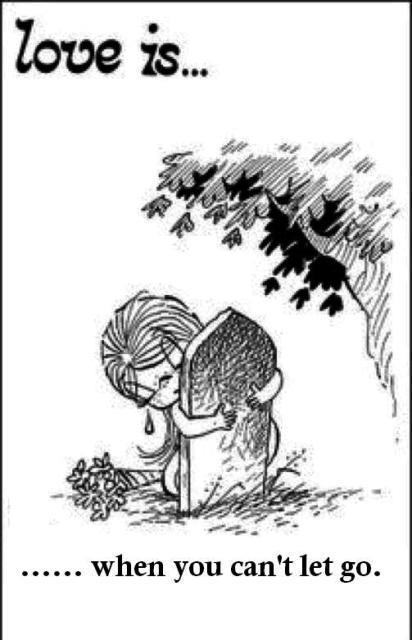
Love is…


148167_365285413560893_1269011302_n


Never have I missed you more than today.


Africa Prayers for the Dead


“Christianity is the predominant religion in EuropeRussiathe Americas, the PhilippinesEast TimorSouthern AfricaCentral AfricaEast Africa and Oceania.[8] There are also large Christian communities in other parts of the world, such as Central Asia and the Middle East, where Christianity is the second-largest religion after Islam. The United States of America has the largest Christian population in the world, followed by Brazil and Mexico.[9]http://en.wikipedia.org/wiki/Christianity_by_country
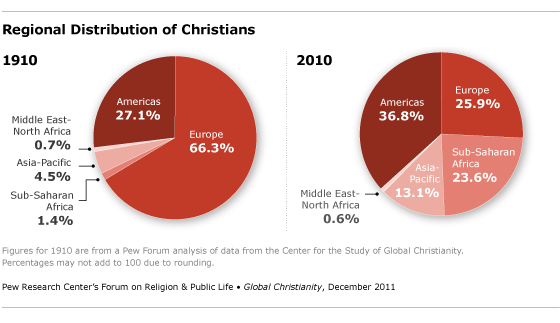

Christianity has grown enormously in sub-Saharan Africa and the Asia-Pacific region, where there were relatively few Christians at the beginning of the 20th century. The share of the population that is Christian in sub-Saharan Africa climbed from 9% in 1910 to 63% in 2010, while in the Asia-Pacific region it rose from 3% to 7%. Christianity today – unlike a century ago – is truly a global faith.http://www.pewforum.org/2011/12/19/global-christianity-exec/

Despite the increase in the number of Christians in Africa superstition still plays a big role. 

In the religions of Africa, life does not end with death, but continues in another realm. The concepts of “life” and “death” are not mutually exclusive concepts, and there are no clear dividing lines between them. In many African languages, the words “we are living a little,” means that the individual is ill, and their “level of life” is very low. Death does not alter or end the life or the personality of an individual, but only causes a change in its conditions. This is expressed in the concept of “ancestors,” people who have died but who continue to “live” in the community and communicate with their families.
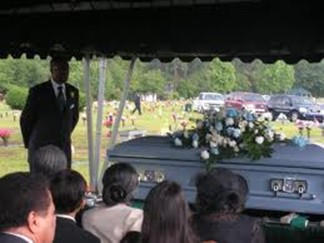
 

The African Concept of Death

Death, although a dreaded event, is perceived as the beginning of a person’s deeper relationship with all of creation, the complementing of life and the beginning of the communication between the visible and the invisible worlds. The goal of life is to become an ancestor after death. This is why every person who dies must be given a “correct” funeral, supported by a number of religious ceremonies. If this is not done, the dead person may become a wandering ghost, unable to “live” properly after death and therefore, a danger to those who remain alive. It might be argued that “proper” death rites are more a guarantee of protection for the living than to secure a safe passage for the dying. There is ambivalence about attitudes to the recent dead, which fluctuate between love and respect, on the one hand, and dread and despair on the other, particularly because it is believed that the dead have power over the living.

Many African people have a custom of removing a dead body through a hole in the wall of a house, and not through the door. The reason for this seems to be that this will make it difficult (or even impossible) for the dead person to remember the way back to the living as the hole in the wall is immediately closed. Sometimes the corpse is removed feet first, symbolically pointing away from the former place of residence. A zigzag path may be taken to the burial site, or thorns strewn along the way, or a barrier erected at the grave itself because the dead are also believed to strengthen the living. Many other people take exceptional pains to ensure that the dead are easily able to return to their homes, and some people are even buried under or next to their homes.

Many people believe that death is the loss of a soul, or souls. Although there is recognition of the difference between the physical person that is buried and the nonphysical person who lives on, this must not be confused with a Western dualism that separates “physical” from “spiritual.” When a person dies, there is not some “part” of that person that lives on—it is the whole person who continues to live in the spirit world, receiving a new body identical to the earthly body, but with enhanced powers to move about as an ancestor. The death of children is regarded as a particularly grievous evil event, and many people give special names to their children to try to ward off the reoccurrence of untimely death.

There are many different ideas about the “place” the departed go to, a “land” which in most cases seems to be a replica of this world. For some, it is under the earth, in groves, near or in the homes of earthly families, or on the other side of a deep river. In most cases, it is an extension of what is known at present, although for some people it is a much better place without pain or hunger. The Kenyan scholar John Mbiti writes that a belief in the continuation of life after death for African people “does not constitute a hope for a future and better life. To live here and now is the most important concern of African religious activities and beliefs. . . . Even life in the hereafter is conceived in materialistic and physical terms. There is neither paradise to be hoped for nor hell to be feared in the hereafter” (Mbiti 1969, pp. 4–5).

The African Concept of the Afterlife

Nearly all African people have a belief in a singular supreme being, the creator of the earth. Although the dead are believed to be somehow nearer to the supreme being than the living, the original state of bliss in the distant past expressed in creation myths is not restored in the afterlife. The separation between the supreme being and humankind remains unavoidable and natural in the place of the departed, even though the dead are able to rest there and be safe. Most African people believe that rewards and punishments come to people in this life and not in the hereafter. In the land of the departed, what happens there happens automatically, irrespective of a person’s earthly behavior, provided the correct burial rites have been observed. But if a person is a wizard, a murderer, a thief, one who has broken the community code or taboos, or one who has had an unnatural death or an improper burial, then such a person may be doomed to punishment in the afterlife as a wandering ghost and may be beaten and expelled by the ancestors or subjected to a period of torture according to the seriousness of their misdeeds, much like the Catholic concept of purgatory. Among many African peoples is the widespread belief that witches and sorcerers are not admitted to the spirit world, and therefore they are refused proper burial—sometimes their bodies are subjected to actions that would make such burial impossible such as burning, chopping up, and feeding them to hyenas. Among the Africans, to be cut off from the community of the ancestors in death is the nearest equivalent of hell.

The concept of reincarnation is found among many people. Reincarnation refers to the soul of a dead person being reborn in the body of another. There is a close relationship between birth and death. African beliefs in reincarnation differ from those of major Asian religions (especially Hinduism) in a number of important ways. Hinduism is “world-renouncing,” conceiving of a cycle of rebirth in a world of suffering and illusion from which people wish to escape—only by great effort—and there is a system of rewards and punishments whereby one is reborn into a higher or lower station in life (from whence the caste system arose). These ideas that view reincarnation as something to be feared and avoided are completely lacking in African religions. Instead, Africans are “world-affirming,” and welcome reincarnation. The world is a light, warm, and living place to which the dead are only too glad to return from the darkness and coldness of the grave. The dead return to their communities, except for those unfortunate ones previously mentioned, and there are no limits set to the number of possible reincarnations—an ancestor may be reincarnated in more than one person at a time. Some African myths say that the number of souls and bodies is limited. It is important for Africans to discover which ancestor is reborn in a child, for this is a reason for deep thankfulness. The destiny of a community is fulfilled through both successive and simultaneous multiple reincarnations.

Transmigration (also called metempsychosis) denotes the changing of a person into an animal. The most common form of this idea relates to a witch or sorcerer who is believed to be able to transform into an animal in order to perform evil deeds. Africans also believe that people may inhabit particular animals after death, especially snakes, which are treated with great respect. Some African rulers reappear as lions. Some people believe that the dead will reappear in the form of the totem animal of that ethnic group, and these totems are fearsome (such as lions, leopards, or crocodiles). They symbolize the terrible punishments the dead can inflict if the moral values of the community are not upheld.
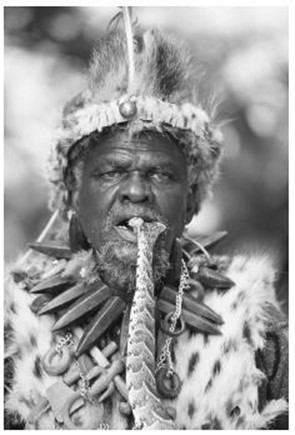

In the village of Eshowe in the KwaZulu-Natal Province in South Africa, a Zulu Isangoma (diviner), with a puff adder in his mouth, practices soothsaying or predicting, with snakes. It is impossible to generalize about concepts in African religions because they are ethno-religions, being determined by each ethnic group in the continent.

GALLO IMAGES/CORBIS

 Burial and Mourning Customs

Death in African religions is one of the last transitional stages of life requiring passage rites, and this too takes a long time to complete. The deceased must be “detached” from the living and make as smooth a transition to the next life as possible because the journey to the world of the dead has many interruptions. If the correct funeral rites are not observed, the deceased may come back to trouble the living relatives. Usually an animal is killed in ritual, although this also serves the practical purpose of providing food for the many guests. Personal belongings are often buried with the deceased to assist in the journey…. Various other rituals follow the funeral itself. Some kill an ox at the burial to accompany the deceased. Others kill another animal some time after the funeral (three months to two years and even longer is the period observed). The Nguni in southern Africa call the slaying of the ox “the returning ox,” because the beast accompanies the deceased back home to his or her family and enables the deceased to act as a protecting ancestor. The “home bringing” rite is a common African ceremony. Only when a deceased person’s surviving relatives have gone, and there is no one left to remember him or her, can the person be said to have really “died.” At that point the deceased passes into the “graveyard” of time, losing individuality and becoming one of the unknown multitude of immortals.

Many African burial rites begin with the sending away of the departed with a request that they do not bring trouble to the living, and they end with a plea for the strengthening of life on the earth and all that favours it. According to the Tanzanian theologian Laurenti Magesa, funeral rites simultaneously mourn for the dead and celebrate life in all its abundance. Funerals are a time for the community to be in solidarity and to regain its identity. In some communities, this may include dancing and merriment for all but the immediate family, thus limiting or even denying the destructive powers of death and providing the deceased with “light feet” for the journey to the other world.

Ancient customs are adapted in many South African urban funerals. When someone has died in a house, all the windows are smeared with ash, all pictures in the house turned around and all mirrors and televisions and any other reflective objects covered. The beds are removed from the deceased’s room, and the bereaved women sit on the floor, usually on a mattress. During the time preceding the funeral—usually from seven to thirteen days—visits are paid by the community to comfort the bereaved family. In the case of Christians, consolatory services are held at the bereaved home. The day before the funeral the corpse is brought home before sunset and placed in the bedroom. A night vigil then takes place, often lasting until the morning. The night vigil is a time for pastoral care, to comfort and encourage the bereaved. A ritual killing is sometimes made for the ancestors as it is believed that blood must be shed at this time to avoid further misfortune. Some people use the hide of the slaughtered beast to cover the corpse or place it on top of the coffin as a “blanket” for the deceased. Traditionally, the funeral takes place in the early morning (often before sunrise) and not late in the afternoon as it is believed that sorcerers move around in the afternoons looking for corpses to use for their evil purposes. Because sorcerers are asleep in the early morning, this is a good time to bury the dead.

In some communities children and unmarried adults are not allowed to attend the funeral. During the burial itself, the immediate family of the deceased is expected to stay together on one side of the grave at a designated place. They are forbidden from speaking or taking any vocal part in the funeral. It is customary to place the deceased’s personal property, including eating utensils, walking sticks, blankets, and other useful items, in the grave. After the funeral, the people are invited to the deceased’s home for the funeral meal. Many people follow a cleansing ritual at the gate of the house, where everyone must wash off the dust of the graveyard before entering the house. Sometimes pieces of cut aloe are placed in the water, and this water is believed to remove bad luck. Churches that use “holy water” sprinkle people to cleanse them from impurity at this time.

In southern Africa, the period of strict mourning usually continues for at least a week after the funeral. During this time the bereaved stay at home and do not socialize or have sexual contact. Some wear black clothes or black cloths fastened to their clothes, and shave their hair (including facial hair) from the day after the funeral. Because life is concentrated in the hair, shaving the hair symbolizes death, and its growing again indicates the strengthening of life. People in physical contact with a corpse are often regarded as unclean. The things belonging to the deceased should not be used at this time, such as the eating utensils or the chairs the deceased used. Blankets and anything else in contact with the deceased are all washed. The clothes of the deceased are wrapped up in a bundle and put away for a year or until the extended period of mourning has ended, after which they are distributed to family members or destroyed by burning. After a certain period of time, the house and the family must be cleansed from bad luck, from uncleanness and “darkness.” The bereaved family members are washed, and a ritual killing takes place. The time of the cleansing is usually seven days after the funeral, but some observe a month or even longer. Traditionally, a widow had to remain in mourning for a year after her husband’s death and the children of a deceased parent were in mourning for three months.

A practice that seems to be disappearing in African urban areas is the home-bringing ritual, although it is still observed in some parts of Africa. A month or two after the funeral, the grieving family, slaughters a beast and then goes to the graveyard. They speak to the ancestors to allow the deceased to return home to rest. It is believed that, at the graves, the spirits are hovering on the earth and are restless until they are brought home—an extremely dangerous situation for the family. The family members take some of the earth covering the grave and put it in a bottle. They proceed home with the assurance that the deceased relative is accompanying them to look after the family as an ancestor. Some Christian churches have a night vigil at the home of the deceased, after the home-bringing. The theologian Marthinus Daneel describes the ceremony in some Zimbabwean churches, where the living believers escort the spirit of the deceased relative to heaven through their prayers, after which a mediating role can be attained. The emphasis is on the transformation of the traditional rite while providing for the consolation of the bereaved family. This example shows how these churches try to eliminate an old practice without neglecting the traditionally conceived need that it has served.

These burial and mourning customs suggest that many practices still prevailing in African Christian funerals are vestiges of the ancestor cult, especially the ritual killings and the home-bringing rites. Because a funeral is preeminently a community affair in which the church is but one of many players, the church does not always determine the form of the funeral. Some of the indigenous rites have indeed been transformed and given Christian meanings, to which both Christians and those with traditional orientation can relate. Sometimes there are signs of confrontation and the changing and discontinuance of old customs to such an extent that they are no longer recognizable in that context.

African funerals are community affairs in which the whole community feels the grief of the bereaved and shares in it. The purpose of the activities preceding the funeral is to comfort, encourage, and heal those who are hurting. Thereafter, the churches see to it that the bereaved make the transition back to normal life as smoothly and as quickly as possible. This transition during the mourning period is sometimes accompanied by cleansing rituals by which the bereaved are assured of their acceptance and protection by God. Because the dominance of Christianity and Islam in Africa has resulted in the rejection of certain mourning customs, the funeral becomes an opportunity to declare faith.

“In the west, marriages are often the biggest life-cycle events. In Africa, it’s funerals by far,” said professor Michael Jindra, co-editor of “Funerals in Africa: Explorations of a Social Phenomenon.”

Jindra explains that such large events, designed to pay respect to the dead and honor one’s roots, also provide a kind of “social glue” for communities in many African societies: They are at the heart of social and cultural life, with status concerns, succession issues and family bonds also at stake.
Counting the costs of saying goodbye

The business of death

Yet, honoring those who’ve passed away can also exact an enormous financial toll on the already emotionally vulnerable relatives.

In South Africa, bereaved families often have to spend significant amounts to host lavish funerals and burial ceremonies. They are expected to host and feed extended relatives who visit from all over the country and can stay for weeks. Other costs include slaughtering a cow or a goat to honor the dead, renting hearse tents and arranging transportation to the burial ground for mourners.

“In many areas, a lot of people spend a lot of money on funerals. Sometimes, it’s out of choice for reasons of status, but other times, it’s simply out of the social pressure, and it is certainly putting burdens on people when they don’t have a lot of money,” said Jindra.

A 2009 report by economists Anne Case and Alicia Menendez found that the average price tag for an “honorable” funeral in South Africa between 2003 and 2005 was about 3,400 rand ($415), which is equivalent to 40% of the average annual household expenditure.  Read more: http://www.deathreference.com/A-Bi/African-Religions.html#ixzz2dBIpmftM


We Africans carry in our heritage the cradle of humanity. We carry the deep sorrows of slavery. We carry the suffering of AIDS leaving whole villages of only children.

We are living on the dark continent with yet so much light. In our African prayers. In our dances. In our stories. In our living. In our dying.

An African farmer used to sit in church for long periods of silence. When he was asked about this, he spoke of his God saying: “I look at him, and he looks at me and it is enough.”

Our prayers take many forms, especially when slavery took us to places far away from Africa. Jamaican reggae is one form. Christian gospels are another form. Yet they are still our prayers. African prayers.


Praise Ye Lord,
Peace be with us.

Say that the elders may have wisdom and speak with one voice.
Peace be with us.

Say that the country may have tranquillity.
Peace be with us.

And the people may continue to increase.
Peace be with us.

Say that the people and the flock and the herds
May prosper and be free from illness.
Peace be with us.

Say that the fields may bear much fruit
And the land may continue to be fertile.
Peace be with us.

May peace reign over earth,
May the gourd cup agree with vessel.
Peace be with us.

May their heads agree and every ill word be driven out
Into the wilderness, into the virgin forest.

– Kikuyu Peace Prayer –

http://www.godprayers.org/Kikuyu-Peace-Prayer.htm


Morning has risen;
God, take away from us every pain,
every ill, every mishap;
God, let us come safely home.

– Pygmy Women’s Prayer –
– The Prayers of African Religion. –
– London. S.P.C.K., Maryknoll. Orbis, 1975. –
– p.32. –


Praise Ye, Ngai … Peace be with us.

Say that the elders may have wisdom
and speak with one voice.
Peace be with us.

Say that the country may have tranquility.
Peace be with us.

And the people may continue to increase.
Peace be with us.

Say that the people and the flock and the herds
May prosper and be free from illness.
Peace be with us.

Say that the fields may bear much fruit
And the land may continue to be fertile.
Peace be with us.

May peace reign over earth,
May the gourd cup agree with the vessel.
Peace be with us.

May their heads agree and
every ill word be driven out
Into the wilderness, into the virgin forest.

Praise ye, Ngai … Peace be with us.

– Kikuyu, Kenya –


Wonderful one, you live
among the sheltering rocks.
You give rain to us people.

We pray to you,
hear us, O Strong One!
When we beg you, show your mercy.

You are in the highest places
with the spirits of the great ones.

You raise the grass-covered hills
above the earth,
and you make the rivers.
Gracious one!

– Rozwi, South Africa –

http://www.dailyom.com/library/000/000/000000461.html


Great is O King,
our happiness
in thy kingdom,
thou, our king.

We dance before thee,
our king,
by the strength
of thy kingdom.

May our feet
be made strong;
let us dance before thee,
eternal.

Give ye praise,
all angels,
to him above
who is worthy of praise.

– Zulu, South Africa –

http://www.dailyom.com/library/000/000/000000461.html


Lyrics to:                     Three Little Birds by Bob Marley

Dont worry about a thing,
cause every little thing gonna be all right.
Singin: dont worry about a thing,
cause every little thing gonna be all right!

Rise up this mornin,
Smiled with the risin sun,
Three little birds
Pitch by my doorstep
Singin sweet songs
Of melodies pure and true,
Sayin, this is my message
to you-ou-ou:

Thanks for the reminder, Felix!


Ope ni fun Olorun,
Gratitude to the Owner of the Realm of the Ancestors,
                                                               Iba Olodumare, Oba ajiki,
Homage to the Creator, the King who we praise first,

                                                                       Mo ji loni,
I awake today,

                                                               Mo wo’gun merin Aye,
I behold the four corners of the World,

Iba Elawori,
Homage to the Spirit of Purity,

Agbegi lere, la’fin ewu l’ado,
He who carves the cloth at Ado in the form of a sculpture,

Eiti Olodumare ko pa’jo iku e da,
The one whose date of death
has not been changed by the wind,

Omo Oluworiogbo,
Child of the Chief Priest who made
all the Heads that exist in Creation.

Iba’se ila Oorun,
Homage to the power of East,

Iba’se iwo Oorun,
Homage to the power of the West,

Iba’se Ariwa,
Homage to the power of the North,

Iba’se Guusu,
Homage to the power of the South,

Iba Oba Igbalaye,
Homage to the King of the Seasons of the Earth,

Iba Orun Oke,
Homage to the Invisible Realm of the Mountains,

Iba Atiwo Orun,
Homage to all things that live in the Invisible Realm,

……….

Iba Okiti biri, Oba ti np’ojo iku da,
Homage to the Averter of the final days,
The King who could change the time of Death,

Iba ate-ika eni Olodumare,
Homage to the mat that cannot be rolled up once laid out,

Iba Odemu demu kete a lenu ma fohun,
Homage to the power that extracts Goodness
from the Realm of the Invisible,

Iba’se awon Iku emese Orun,
Homage to the dead, the messengers of the Invisible Realm.

………..

– Iba’se, Parts of the Ifa Prayer of Praise, West Africa –


http://www.ijfm.org/PDFs_IJFM/02_3_PDFs/2_3%20Brown%20african%20funeral%20ceremony%20fixed2.pdfhttp://www.thefuneralsource.org/hi01.html#

http://www.deathreference.com/A-Bi/African-Religions.html

APA:
Bizarre rituals know of any? – Page 13 – David Icke’s … (n.d.). Retrieved from http://www.davidicke.com/forum/showthread.php?p=1059082053

Christian prayers for the dying


All religions have prayers for the dying. There is so much common ground between the different religions and their prayers. I will post different religions prayers for their dying.

Kahlil Gibran – 1883-1931 writes…If you would indeed behold the spirit of death, open your heart wide unto the body of life. For life and death are one, even as the river and the sea are one.

Christians believe in the redeeming power of love.

Christians are encouraged to be childlike in their faith; to pray for forgiveness regardless of how far they had strayed.

Christians believe in the resurrection of the body. One week before her death Vic requested that she be served Holy Communion. I believe that Vic was comforted by the words of John 6:54 that reads “Whoever eats my flesh and drinks my blood has eternal life, and I will raise them up at the last day.”  Vic truly believed in the words of Paul in Romans 1:16b, “because it is the power of God that brings salvation to everyone who believes…

Here are some examples of Christian Prayers that can be prayed with the dying:-

“Oh Righteous Father, we know our days are numbered in your book of life and that precious in your sight are the death of your saints. We are so thankful that we can stand on your promises and know that when we die, we are instantly in your holy presence. All of those who have gone before us, beloved friends and family, are there waiting for us. We know that death cannot hold us because just as Jesus died and was resurrected, we too know that we also will be raised to eternal life. There is such peace in knowing that there will be no more tears, no more sorrow, and no more pain. What great and precious promises you have given us. We know that nothing can ever separate us from your love. No one or nothing can snatch us out of Your mighty hands. Blessed Lord, please be with [name] in this time and with his/her family; to comfort, strengthen, and encourage them during the coming difficult days and times ahead. We pray that Your tender mercies be upon [name] now. I thank God for [name] and the faithfulness that he/she has shown in their life. [name] has placed his/her trust and faith in You and we know that you will never leave [name] nor forsake him/her. We thank you for your precious gift of salvation which came through the precious the blood of the Lamb of God at supreme cost. Our atonement was made possible by Him and has made us one with You. We ask these things in the power, majesty, glorious, and most holy name of our Saviour, King, Master, and Lord, Jesus Christ. Amen.

Read more: http://www.whatchristianswanttoknow.com/how-to-pray-with-the-dying-5-helpful-tips/#ixzz2i6njL0rW


Saying “Thank you” and “Good-bye” – Helen Meier, Hope Hospice, Dublin, CA

________(person’s name) thank you for all you have given me, your family, friends, and the world. You have impacted my life with your love, your caring and your wisdom. Now that you are gone, I will carry all your love and everything I learned from you within me. The essence of who you were as a person will live within me and within others. You will continue to give to the world as we pass on to others what we learned from you. I will miss you, but will have joy in remembering all you meant to me. Each thing you touched will bring you to mind. Your laugh, your smile, your words will resound in my mind and heart. Good-bye dear one.

John 14:1-3

Let not your hearts be troubled: believe in God, believe also in me. In my Father’s house are many rooms; if it were not so, would I have told you that I go to prepare a place for you? I will come again and will take you to myself, that where I am you may be also.

The Lord is my shepherd;
I have everything I need.
He lets me rest in green meadows;
he leads me beside peaceful streams.

He renews my strength.
He guides me along right paths,
bringing honor to his name.

Even when I walk
through the dark valley of death,
I will not be afraid,
for you are close beside me.

Your rod and your staff protect and comfort me.
You prepare a feast for me
in the presence of my enemies.

You welcome me as a guest,
anointing my head with oil.
My cup overflows with blessings.

Surely your goodness and unfailing love
will pursue me all the days of my life,
and I will live in the house of the Lord forever. Amen

– The Bible, Psalm 23 –

Benedict,
when the storm rages
around me,
and I can hold on no more,
when the waves of fear engulf me
and I am weary,
battered and sore,
take me then and steer me,
storm-tossed, broken and afraid,
into the arms of your safe harbor
safely home.
Amen

– Prayer to St. Benedict –
– Friar Dennis Ward O.S.B. –

http://www.facebook.com/group.php?gid=2342444733

Our Father who art in heaven,
hallowed be thy name;
thy kingdom come;
thy will be done on earth as it is in heaven.

Give us this day our daily bread,
and forgive us our trespasses,
as we forgive those who trespass against us.

And lead us not into temptation;
but deliver us from evil.

For thine is the kingdom,
the power and the glory,
for ever and ever.
Amen

– Lord’s Prayer, traditional –

Lord, make me an instrument of Thy peace;
where there is hatred, let me sow love;
where there is injury, pardon;
where there is doubt, faith;
where there is despair, hope;
where there is darkness, light;
and where there is sadness, joy.

O Divine Master,
grant that I may not so much seek
to be consoled as to console;
to be understood, as to understand;
to be loved, as to love;
for it is in giving that we receive,
it is in pardoning that we are pardoned,
and it is in dying that
we are born to Eternal Life.
Amen.

– Peace Prayer of St Francis –

Unto God’s gracious mercy
and protection we commit you.
May the Lord bless you and keep you;
may the Lord make his face to shine upon you
and give you peace evermore.
Amen

– The Bible, Chapter 6, Verses 24-26 –

To every thing there is a season,
and a time to every purpose under the heaven:
A time to be born, and a time to die;
A time to plant, and a time to pluck up that which is planted;
A time to kill, and a time to heal;
A time to break down, and a time to build up;
A time to weep, and a time to laugh;
A time to mourn, and a time to dance.

– The Bible, Ecclesiastes 3, Verses 1-4 –

Blessed are the poor in spirit:
for theirs is the kingdom of heaven.

Blessed are they that mourn:
for they shall be comforted.

Blessed are the meek:
for they shall inherit the earth.

Blessed are they which do hunger
and thirst after righteousness:
for they shall be filled.

Blessed are the merciful:
for they shall obtain mercy.

Blessed are the pure in heart:
for they shall see God.

Blessed are the peacemakers:
for they shall be called the children of God.

Blessed are they which are persecuted for righteousness’ sake:
for theirs is the kingdom of heaven.

– The Sermon on the Mountain, Matthew 5:3-10 –

Watch thou, dear Lord,
with those who wake,
or watch, or weep tonight,
and give thine angels charge
over those who sleep.

Tend thy sick ones, Lord Christ.
Rest thy weary ones.
Bless thy dying ones.
Soothe thy suffering ones.
Pity thine afflicted ones.
Shield thy joyous ones.
And all, for thy love’s sake.
Amen.

– Saint Augustine’s Evening Prayer –


Credit: http://www.whatchristianswanttoknow.com/how-to-pray-with-the-dying-5-helpful-tips/

http://www.beliefnet.com/Prayers/Protestant/Death/Prayer-For-Someone-Who-Is-Dying.aspx

http://www.sofriendsofhospice.org/spiritual/words.shtml

The boys grief …


He is six-foot tall and wears a number 11 shoe. He has a beautiful open face, perfect teeth and a brilliant smile. He is very bright, a gifted sportsman, he is the “silent” type. He is Vic’s youngest son.

Last night he received an award at the school’s prize giving. His aggregate for the year 84.7% with 8 distinctions.

This is the most difficult year of his life. He lost his mom in the beginning of the academic year.


Jared is the perfect older brother.  He is fiercely protective of his younger brother.  Jared is gentle and caring.  He has a white soul…

On the surface the boys are coping well. They are “getting on” with their lives.


Thank goodness for social media…It gives me an insight into what is happening behind their stoic appearances.

Jon-Daniel’s WhatsApp status is “Live until you die.” That is the example his Mom set…

Jared posted on Facebook on the 18th of September “Can’t believe that it has already been 8 months… Miss you mommy… It feels like a lifetime already… Love you mom  always in our heart♥ forever in our memories…

On the 18th of September Jon-Daniel posted: “How? I ask myself.. It already been 8 months without the greatest Mommy in the world! Time has flown since January, but the memories have stayed. And they will always stay, along with that special place in my heart that is only for MY MOMMY! Love you always Mom, miss you stax!”

 On the 26th of September Jared posted on Facebook “Missing you mommy… you were always there for a laugh

The day of Stepping Stone Hospices’ official opening Jon-Daniel posted “Stepping Stone Hospice was officially opened this evening. Amazing to see 1 person’s dream can turn into something so big! And so amazing how much people will do for somebody they don’t know. Thank you to all that attended!”

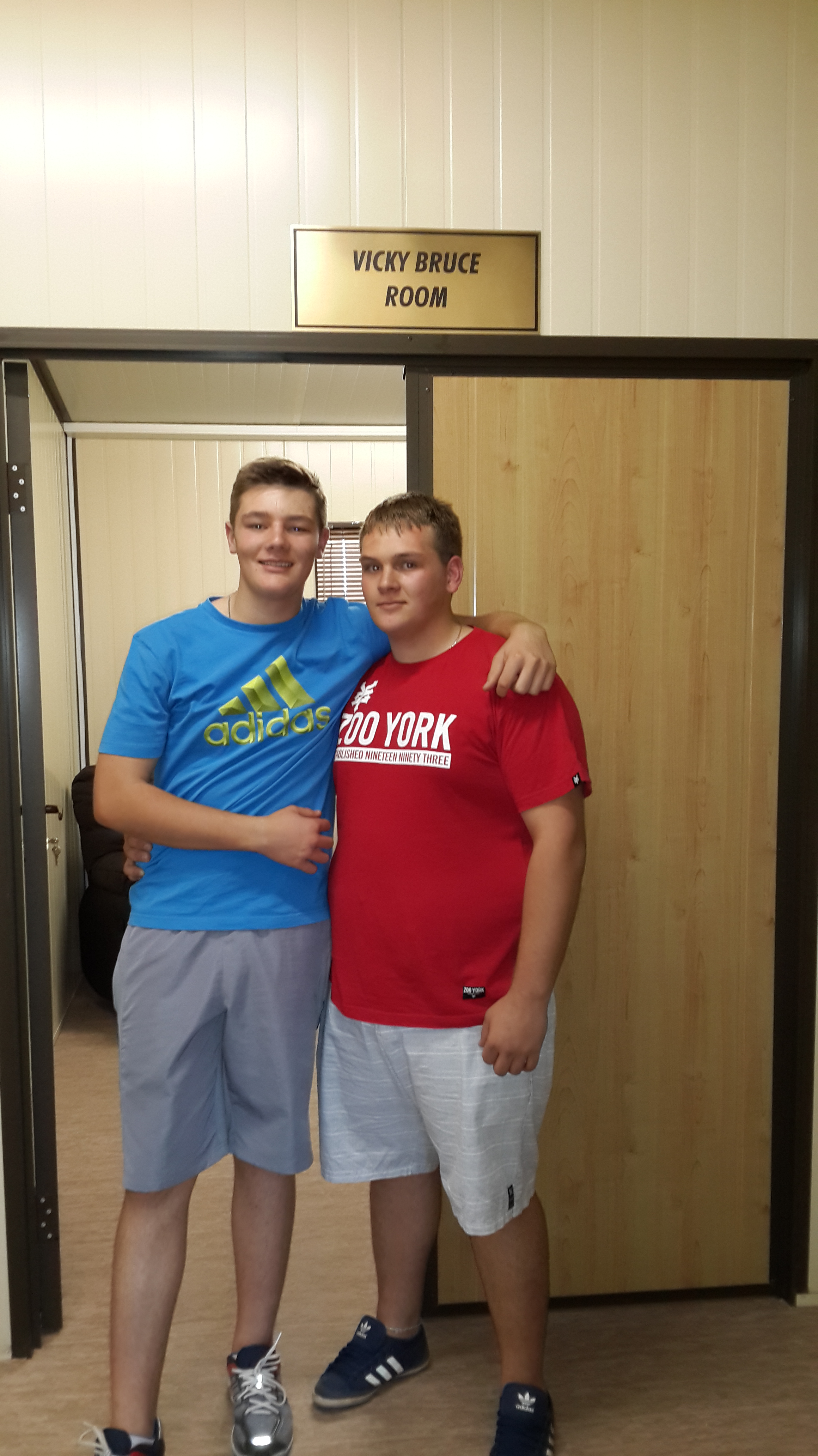
 He cried in the doorway of the Vicky Bruce Room

 On the 11th of October he posted on Vic’s Facebook page “Mommy, I miss you! When are you coming home?”

 I am helpless in taking the children’s pain away. Their pain and grief is still so raw and deep.

The stress started years before Vic died. The boys grew up knowing that their Mommy was ill and in a lot of pain. They grew up living with Vic’s imminent death and dreadful suffering.

Teenagers appear to feel grief more intensely than adults, especially if one of their parents has died. The Adolescent Life Change Event Scale (ALCES), which mental-health specialists use to help quantify the events that are the most stress-inducing in teenagers, ranks a parent’s death as the number- one cause of adolescent stress. Second is the death of a brother or sister, followed by the death of a friend.

Teenagers are embarrassed by displays of grief and struggle to express their emotions. The boys seldom talk about their grief. They will tell me when the other brother is having a rough day….

 Jared was very concerned about how his little brother would cope with his first birthday without his Mom. He went to great measures to ensure that his little brother was “protected” from the grief on his birthday. He blew up 40 balloons so Jon-Daniel would wake up to “fun”. (Vic always had lots of balloons on the boys birthdays.)

 The firsts are coming fast and furious now. The first birthdays, prize giving’s, confirmations without their Mommy… Jared and my birthdays, Christmas and New Year is looming…

 I love the boys with every fibre in my body. I hate that they occasionally walk in on me when I am crying. I hate that I cannot make their pain better. I hate that I am so helpless.

 I wish I had died and not Vic. I wish that I could change places with my child. I wish I could rip the heartache out of my grandsons’ lives and hearts. I wish I could protect them.

 I wish I could shake the cold world out there and make them realise how much pain the boys are in….

Please pray for Vic’s boys. Pray that they will heal. Pray that God will hold and protect them. Pray that they will learn to be happy again. 

I pray that one day I will hear their happy, uncontrolled laughter echo through the house again.


https://tersiaburger.com/2013/03/20/i-love-you-angel-child/

https://tersiaburger.com/2013/09/18/the-shadow-of-grief/

https://tersiaburger.com/2013/09/11/your-children-are-not-your-children/

https://tersiaburger.com/2013/06/07/mommys-dream-is-coming-true/

A Poem About a Mother’s Love for Her Very Sick Child


I posted this when Vic’s death was a future event.  I did not realise how dreadful the loss would be.  How devastating the longing for my child.  How severe the physical heartache would be… Today I would give everything I own just to hug and hold Vic one more time.

  Image

I know that I would do all things for you.
My spirit would always take care of you.
And when I die and leave this world behind.
You can be rest assured that my love will stay behind.

Even though sometimes we’re far apart.
You have always remained right here in my heart.
I will forever whisper in the wind
Unconditional love that’ll forever stay within.

If only I could go wherever you go
So I could do things I need to do for you.
Since I can’t, the best sacrifice I can give
is keep you in my heart and allow you to leave.

I’m lifting up the burden in your heart
‘Cause I know that you don’t know where to start.
I’m transferring all the pain inside of you
Into my care, into my heart, and now it’s through.

I love you so much and I know that I can bear
This greatest pain to let you go, I swear.
Know in your heart that my love will forever stay
Even though I would seem so far-away.

I’ll be your strength that’s why I’m relieving you
Of all the pain and tears inside of you.
No need to worry for all your pain will be gone.
It will be with me now, and I shall carry on.

You may think I’m letting you go without a fight.
If you only knew how I fought for you each night.
Just remember that there are signs everywhere.
So look around and acknowledge that they are there.

God said to me that love will always prevail.
And each day there is a tale for you to tell.
If you could already see the signs before your eyes.
Embrace it now. Let it stay. It is your guide.

God said the signs may be a word or two
When you least expect it, it is said to you.
It may also be the people that you have met.
Places, names, or things that you kept.

God told me to tell all these things to you
So happiness would set in and peacefulness, too.
I’m always here, and I’ll always love you.
I never wanted you to be in pain. It’s OK for you to go.

http://authspot.com/poetry/a-poem-about-a-mothers-love-for-her-very-sick-child/?fb_action_ids=3587335596077&fb_action_types=og.likes&fb_source=timeline_og

Deathbed promises kept and broken


During the month of August I again stood next to a deathbed. It was next to the deathbed of one of our patients.

I was touched by the absolute outpouring of love from the family to the patient. I have seen it at almost every single deathbed I have stood next to…. The second death I ever witnessed was weeks before my mother-in-law died. My Mother-in-Law was in a hospital. The lady opposite her was dying and moved into a dying-room. I was allowed to sit with her. I prayed for her and tried to comfort her. I spoke to her almost non-stop for 11 hours. In the evening her husband came to visit. He was not told that his wife was dying by the hospital staff…

“What is wrong with my wife?” he asked

“She is very ill” I said

“When will she come home?” she asked.

“You must speak to the staff” I said

“They say nothing” he said

“Your wife is dying… I am so sorry.”

I know it was not my place to tell this poor man that his wife was dying. But, if I hadn’t he would have had to live with the fact that hours after visiting hours were over, she died… He got to say goodbye.

I sat with the woman until she died. She was petrified of death. I could see that they were indigent people. Poorer than poor.

She knew she was dying. She was desperately trying to stay alive. Trying to console and calm her I asked her whether she was scared. She nodded. I asked her whether she was worried about something. Again she nodded. I asked her whether she was worried about her children. She again nodded.

In the heat of the moment I promised her I would help her husband look after her children… I made a deathbed promise.

The next day I tried to get her family’s contact details from the hospital. They refused to give it to me.

I have had to live with the fact that I promised a dying woman that I would take care of her children and that I broke that promise.

Extravagant promises to dying loved ones often pose an ethical conflict, defined as when opposing acts each fulfil an ethical value, but neither can achieve both.  The situation also arises when one is tempted to lie to dying friends and loved ones out of kindness. A mother and daughter are involved in a fatal car accident; the daughter is dead, the mother is dying. “Is our daughter all right?” the fading mother asks her husband.

In such a case, it is reasonable and ethical to conclude that the kind answer, “Yes,” is more ethical than the truthful answer, “No.” A promise to a dying loved one may be an exception to the usual rule that it is unethical to make a promise one cannot or will not fulfil.

Often ridiculous and selfish promises are coerced from the loved ones standing next to a death bed. When we stand there we promise freely…we want to give the dying person that final peace of mind.

A classic example of a deathbed promise made in good faith is depicted in the black comedy “Where’s Poppa?” In this movie, the son promises his father, he would never place his senile mother in a home… At the time it was a reasonable promise but becomes increasingly more difficult to keep as the mother becomes more demented and senile. The vicious woman destroys every aspect of his life….

“Promises openly and freely made on the initiative of a dying individual’s loved one are true commitments. Promises coerced by a dying friend or relative and made out of kindness or guilt, on the other hand, should be re-evaluated at a less emotion-charged time. Both varieties of death-bed promises, however, create ethical obligations. They just can’t be as strong as the obligations created by promises to the living.”

I have stuck to every promise I made Vic. Many of the promises were heartbreakingly difficult to keep. Others were easy.

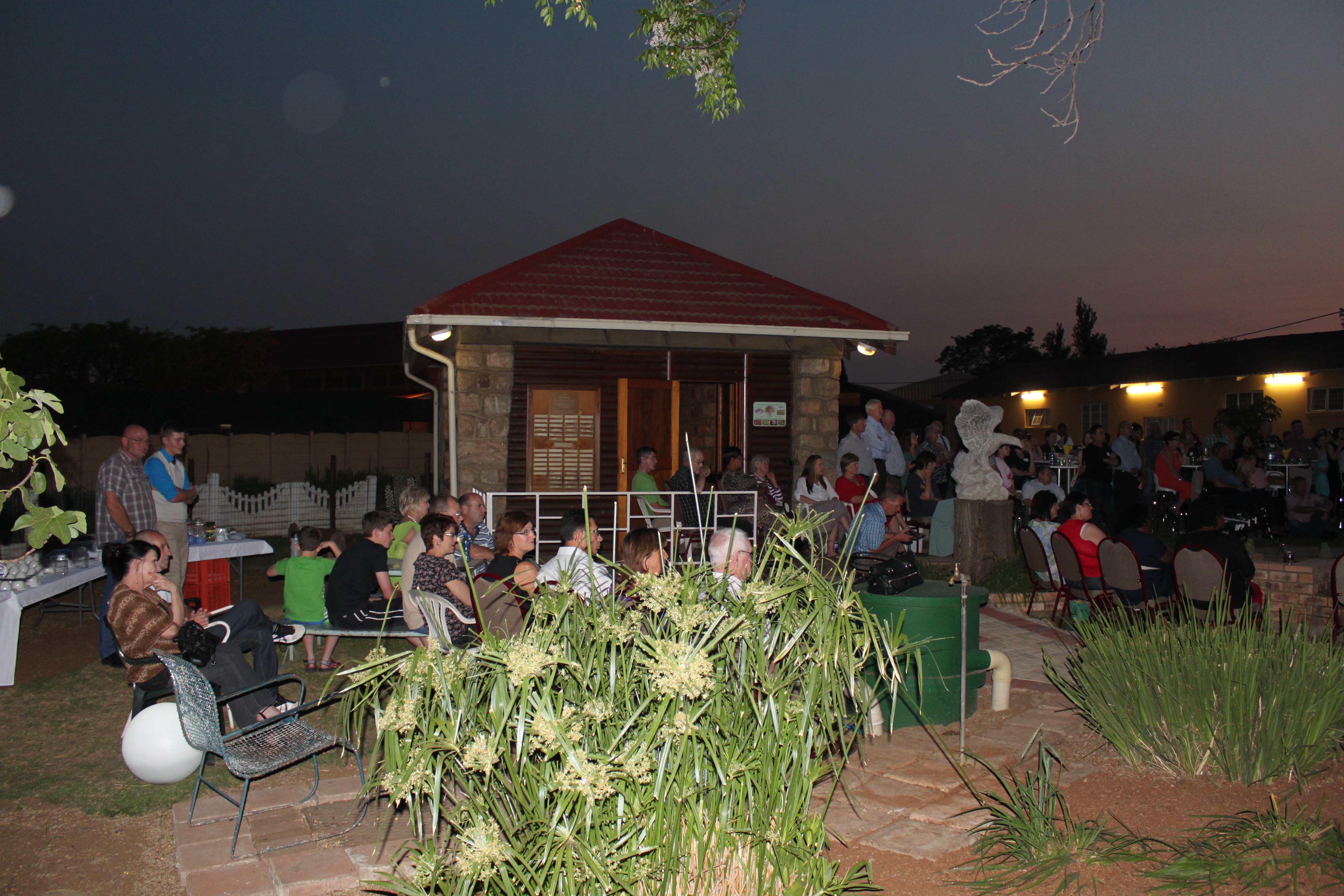
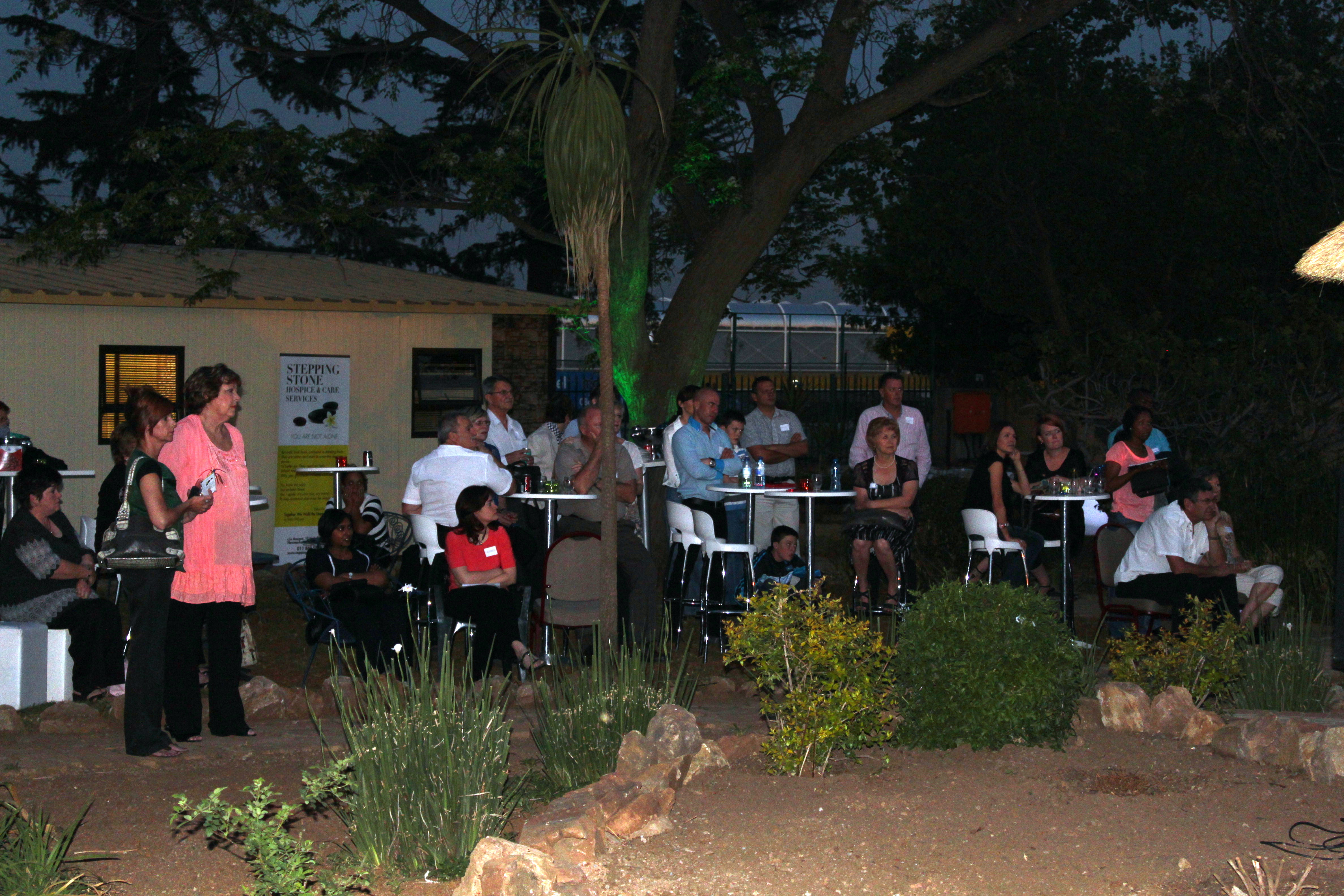
On Wednesday the 9th of October 2013 we had the official opening of Stepping Stone Hospice’s building.

A captive audience
A captive audience

IMG_1321

It is one promise I was able to keep.

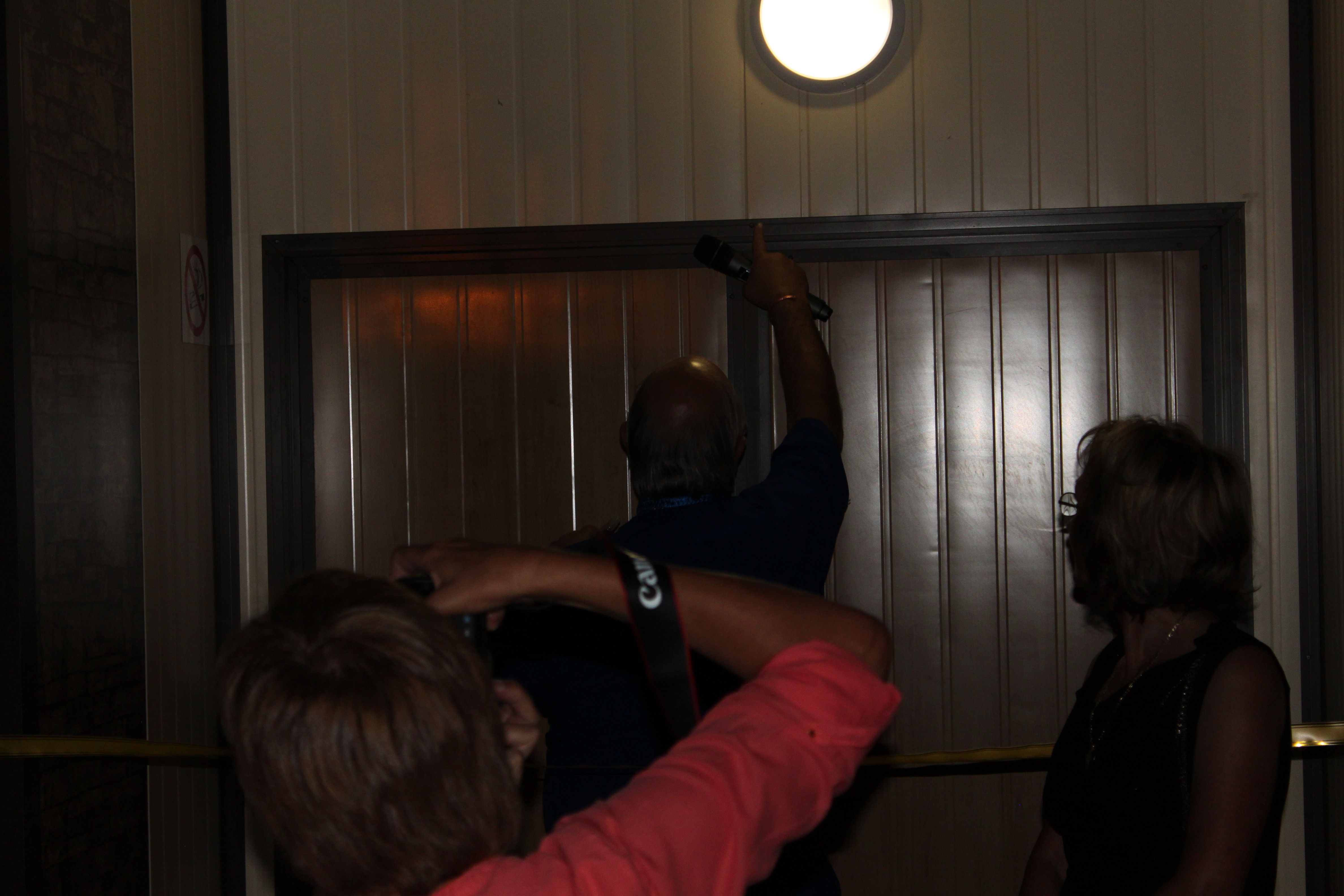
The entrance to Stepping Stone Hospice being blessed

IMG_1344

The boys outside the Vicky Bruce Dignity Room

An elephant cow’s mourning


We are spending a couple of days on a Game Reserve. It is a beautiful place where you are able to make peace with your soul. It was one of Vic’s favourite places. Vic loved the Kruger national Park too and on her last visit there witnessed a Cheetah kill!!

When we were told that Vic was terminal she fled to Mabalingwe. When she got divorced – Vic fled to Mabalingwe. This was Vic’s bit of Heaven on earth.

Vic has not been able to come to Mabalingwe for a couple of years. The roads are bad and it is a 2.5 hour trip. Just too far for her frail little body. Last year Vic was too ill and it was also Jared’s confirmation weekend.

Jared helping his Mommy to her seat in Church. 23.9.2012

The last time Vic came to Mabalingwe was in 2008. She photographed a herd of elephants. My Christmas gift, that year, was a beautifully framed enlargement of the elephant cow with her babies. Vic wrote a touching note on the back on the picture saying that I was just like the elephant cow – the matriarch of the family. This photograph is one of my most treasured possessions.

Vic's Photo
Vic’s Photo

The first time I was compared to an elephant cow I was appalled! I have however learnt so much about these amazing animals from Vic.

Elephants are widely believed to mourn the deaths of members of their herd, and even pay homage to long-dead elephants.

A 2005 study in the UK found the creatures displayed traits similar to humans and, coming across the remains of an elephant, would gently touch the skull and tusks with their trunks and feet. It is thought that hovering around the carcass and examining the bones and skull by smelling, touching and moving the bones around, is an attempt to recognize whom it was… Some elephants have been seen to weep and others make sounds associated with grief as they cover the body with leaves and branches before keeping a silent vigil. When a member of the herd has passed away, either due to fights or injury, the entire herd would gather around the dead elephant and stay there, not eating, and not allowing anything near it for 18 hours to 24 hours. Mothers of stillborn infants appear to grieve for days over her dead infant, crying and trying to revive it, before finally moving on.

“Elephants, the largest land animals on the planet, are among the most exuberantly expressive of creatures. Joy, anger, grief, compassion, love; the finest emotions reside within these hulking masses. Through years of research, scientists have found that elephants are capable of complex thought and deep feeling. In fact, the emotional attachment elephants’ form toward family members may rival our own.

 Joy is an emotion that elephants have no shame in showing. They express their happiness and joy when they are amongst their loved ones-family and friends. Playing games and greeting friends or family members all elicit displays of joy.

But the one event that stirs a level of elephant happiness beyond compare is the birth of a baby elephant. In Echo: An Elephant to Remember, the birth of Ebony is one such occasion. The excitement of several of the females in Echo’s family can’t be contained as they are heard bellowing and blaring during the birth of the new baby.

An elephant reunion is a joyful meeting between related, but separated, elephants is one of exuberance and drama. The greeting ceremony marks the incredible welcoming of a formerly absent family member. During the extraordinary event, the elephants about to be united begin calling each other from a quarter a mile away. As they get closer, their pace quickens. Their excitement visibly flows as fluid from their temporal glands streams down the sides of their faces. Eventually, the elephants make a run towards each other, screaming and trumpeting the whole time. When they finally make contact, they form a loud, rumbling mass of flapping ears, clicked tusks and entwined trunks. The two leaning on each other, rubbing each other, spinning around, even defecating, and urinating (for this is what elephants do when they are experiencing sheer delight). With heads held high, the reunited pair fill the air with a symphony of trumpets, rumbles, screams, and roars. Bliss.

 There is no greater love in elephant society than the maternal kind. Nobody who observes a mother with her calf could doubt this. It is one of the most touching aspects of elephant social customs. The calf is so small compared to the adult that it walks under its mother, who, incredibly, does not step on it or trip over it. Mother and child remain in constant touch. If a calf strays too far from its mother, she will fetch it. The mother often touches her child with trunk and legs, helping it to its feet with one foot and her trunk. She carries it over obstacles and hauls it out of pits or ravines. She pushes it under her to protect it from predators or hot sun. She bathes it, using her trunk to spray water over it and then to scrub it gently. The mother steers her calf by grasping its tail with her trunk, and the calf follows, holding its mother’s tail. When the calf squeals in distress, its mother and others rush to its protection immediately. It is easy to see why the bond between mother and daughter lasts 50 years or more.

 One of the most moving displays of elephant emotion is the grieving process. Elephants remember and mourn loved ones, even many years after their death. When an elephant walks past a place that a loved one died he or she will stop and take a silent pause that can last several minutes. While standing over the remains, the elephant may touch the bones of the dead elephant (not the bones of any other species), smelling them, turning them over and caressing the bones with their trunk. Researchers don’t quite understand the reason for this behaviour. They guess the elephants could be grieving. Or they could they be reliving memories. Or perhaps the elephant is trying to recognize the deceased. Whatever the reason, researchers suspect that the sheer interest in the dead elephant is evidence that elephants have a concept of death.

 Researchers have described mother elephants who appear to go through a period of despondency after the death of a calf, dragging behind the herd for days. They’ve also witnessed an elephant herd circling a dead companion disconsolately. After some time, and likely when they realized the elephant was dead, the family members broke off branches, tore grass clumps and dropped these on the carcass. Another researcher noted a family of African elephants surrounding a dying matriarch. The family stood around her and tried to get her up with their tusks and put food in her mouth. When the rest of the herd finally moved on, one female and one calf stayed with her, touching her with their feet.

Terror, rage and stress, unfortunately, are also commonplace in the elephant repertoire of emotions. Terror afflicts baby African elephants who wake up screaming in the middle of the night after they have witnessed their families murdered and poached — a type of Post Traumatic Stress Disorder.

Some researchers suggest a species-wide trauma is taking place in wild elephant populations. They say that elephants are suffering from a form of chronic stress after sustaining decades of killings and habitat loss. The recent surge in cases of wild elephant rage reported by the media is a sad indicator of the kind of stress that wild elephants are undergoing. Nearly 300 persons are killed every year by wild elephants in India. But the increasing numbers of deaths are closely correlated to the ever-increasing human presence in traditional wild elephant habitats, as well as the the effects of climate change, and loss of territory and resources. The ongoing competition between elephants and humans for available land and resources is leading to ever more unfortunate and often deadly consequences.

 Human activity does more than put a stress on elephants to find resources. It can often disrupt the complex and delicate web of familial and societal relations that are so important in elephant society. Calves are carefully protected and guarded by members of the matriarchal elephant family. Any perception of danger triggers a violent reaction from the matriarch and, subsequently, the entire family. The extremes a family will go to protect a vulnerable new calf are reported in the news stories as fits of unprovoked “elephant rage.” Charging a village, storming into huts where harvested crop is stored, plundering fields and, if disturbed, turning violent are some of the instances reported by the media.

 Compassion is not reserved for offspring alone in elephant society. Elephants appear to make allowances for other members of their herd. Observers noted that one African herd always traveled slowly because one of its members had never recovered from a broken leg. And in another case, a park warden reported a herd that traveled slowly because one female was carrying around a dead calf. One perplexing report was of an adult elephant making repeated attempt to help a baby rhinoceros stuck in the mud. She continued to try to save the baby rhino despite the fact that its mother charged her each time. Risking her life for the sake of an animal that is not her own, not related to her, or even her own species is remarkably altruistic in nature.

 While there is a great deal more to learn about what elephants feel, such accounts are astonishing. They reveal a creature that weeps, revels, rages and grieves. They lead us to believe that the depth of elephant emotional capacity knows no limit. They are striking for they suggest that elephants act on feelings and not solely for survival.

So my baby girl, tomorrow I shall start looking for the elephants. I will remember your exuberant excitement and joy when you saw the herd. I will remember your words “Mommy, you are just like that elephant matriarch. You also protect and care for your family.”

Bottom-line, if animals mourn how can we as mothers be expected “to move along”…

092013_1954_Anelephantc5.jpg

http://www.pbs.org/wnet/nature/episodes/echo-an-elephant-to-remember/elephant-emotions/4489/

http://www.dailymail.co.uk/news/article-2090915/Well-forget-Elephants-say-sad-farewell-month-old-calf-died-heart-defect.html

http://www.huffingtonpost.com/2012/01/25/lola-baby-elephant-dies-heart-herd-mourns_n_1232007.html

http://perezhilton.com/teddyhilton/2012-06-22-elephants-mourning-death#sthash.YznTAxLx.dpbs

The shadow of grief


Grief becomes a shadow. It finds you and follows you. At times the shadow is small and then at times it is big.

Your shadow is a constant companion. It keeps up with your pace… It will run with you but it will also crawl with you. When you stop it will stop.

It follows you into the valleys of despair and will climb mountains of triumph with you. Grief is a constant companion.

When you are in the deepest valley your shadow is there. When at the heights of the highest mountain it is still there.

A shadow is a dangerous thing. If offers a wonderful hiding place. A place to lose one self. At times the shadow invites me in and I get lost in my shadow of grief. In the shadow I am invisible and no one can see my pain, my sense of loss, my loneliness. My shadow is a safe haven where I get to become one with my grief.

The boys are a light that draws me out from my shadow. Hospice and my faith is a light that draws me out from my shadow.

The grief of losing a child is not only on high days and holidays. Grief follows you on bad days, good days, every day… It gets into bed with you and awakens with you.

It even permeates your dreams.

Today it is 8 months since Vic died. Not a single day has passed that I have not been acutely aware of the shadow of grief that accompanies me on my journey. Has it become a journey of recovery? No, I doubt it. I think it is too soon. I do have better days…Then I have days where I walk into a supermarket and see Vic’s brand of deodorant or shampoo. I will put out my hand to touch a @$*# tin of deodorant and tears will well up in my eyes.

For heaven’s sake! A stupid tin of deodorant now has the ability to reduce me to tears!

Today I stood outside the Hospice building. It is nearing completion. I experienced a profound sense of achievement. Pride and satisfaction welled up in my heart but disappeared into that massive, gaping hole left by Vic’s death.

“This is because my child died” it rushed through my brain….

Of course someone would have started a Hospice. That I don’t doubt for one second. Maybe the rest of the team would have been involved. Maybe the financial backing would have been better – who knows? The fact remains that the reason I got involved is because my child died and I promised her that her death would not be futile.