“How did it get late so soon” – Dr Seuss


Two minutes to twelve…..

Today I read a lovely blog that Andrew had reblogged.  http://lymphomajourney.wordpress.com/2012/11/10/living-with-cancer-its-about-time-nytimes-com/

Several studies have suggested that when dealing with terminal illnesses, especially cancer, doctors are usually incorrect in their prognosis, nearly always tending to believe that their patients will live longer than they actually do. 

In one study involving patients in Chicago hospice programs, doctors got the prognosis right only about 20 % of the time, and 63% of the time overestimated their patients’ survival.

Interestingly, the longer the duration of the doctor-patient relationship, the less accurate was the prognosis. “Disinterested doctors . . . may give more accurate prognoses,” the authors wrote, “perhaps because they have less personal investment in the outcome.” http://www.kevinmd.com/blog/2012/04/doctors-incorrect-prognosis-terminal-illness.html

Eight years ago we were told that Vic’s life was “compromised” and that she would die within the next 5 years.  Eight years later Vic is still alive.    Maybe Vic’s doctor is too close to Vic….

Eleven years ago Vic had blotched back surgery setting her off on a journey filled with pain, 81 abdominal surgeries, years in hospital and millions of rands worth of medical expenses.

Vic realized that her life had been compromised and started saying “If only I can see Jared go to school…”  I remember her joy the first day Jared went to school.  Then she said “If only I can live to see Jon-Daniel go to school…”  I remember how desperately ill she was the day Jon-Daniels started school….

Now both her boys are in High School.  I never hear Vic saying “I wish” anymore.

Tonight we discussed going to the coast for a week in January.  Vic just shook her head sadly and said “It is too far Mommy.  Even if I fly down I think it will be too much for me…”

It is all about time.

Time grinds to a halt when Vic needs her 4 hourly pain medication and there is an hour to go… when she screams from pain and her blood pressure is too low for more pain medication to be administered…

The longest nights are the nights before surgery and after surgery.  The longest passage is the passage outside the operating theater and ICU.

Whilst I was in the UK Vic did well.  She fired her nurse and administered her own injections into her legs!  I have been home for six days and Vic is really ill.  I expected her to have the “up-time” whilst I was gone.  I knew that she would use every ounce of her residual strength to be “good” while I was gone.  Vic bounced around and amazed everyone who came into contact with her.  Cr Ceza, her Hospice sister, however spoke to her in the presence of Danie and Esther and told her that the ONLY reason she was feeling great was because her pain control was optimal.  Her body would however betray her.  She said that Vic’s body has started shutting down….slowly but surely.  The process is inevitable… I believe that Hospice is wrong.  They have to be wrong.

Tonight I am sitting here just wondering where time has gone.

The Blog I read today articulated my thoughts and emotions so accurately

“In the immortal words of Dr. Seuss, “How did it get so late so soon?” Without much of a future, surely time will again change.   A lot can happen in a year — think of the helpless infant becoming a walking, talking toddler in 9 or 10 months. Time moves more slowly for small children, since a year of a 2-year-old’s life is 50 percent of that life. A terminal diagnosis may also slow down time. The next year might be 100 percent of what’s left of my existence.”

Sometimes the time left seems too long; too many catastrophes could injure those I love. Sometimes it seems too short; there are so many suspenseful stories unfolding around me, and I want to see how they will turn out. Those for whom time’s chariot is indeed winged often attest to a heightened appreciation of their fast-fading prospects. And then there is always the dream of borrowed time, that numinous period beyond the predicted end, like a stay of execution, which must be fraught with its own blessings and curses. .  http://lymphomajourney.wordpress.com/2012/11/10/living-with-cancer-its-about-time-nytimes-com/

We have already had so many “extra” years.  But the fact remains that Vic is ill.  Today she is more ill than yesterday or even last week or last month.  It is not an UTI causing the pain and fever.  Her pain control is good enough to mask symptoms.  Waves of severe nausea and cramping remain…

I don’t even want to consider the possibility that the pain is caused by Vic’s organs slowly starting to shut down….. One organ after another….  I have read that it feels “uncomfortable”.  It is called terminal agitation.

Only time will tell….  Time is all we have….

How did it get late so soon?

Related Posts:

https://tersiaburger.com/2012/10/15/remission-15-10-2012/https://tersiaburger.com/2012/08/02/5-stages-of-dying/  https://tersiaburger.com/2012/08/08/dummys-guide-for-the-parents-of-a-terminally-ill-child/ 

https://tersiaburger.com/2012/07/02/vic-regrets-not-going-to-italy/ https://tersiaburger.com/2012/07/20/thank-you-god-20-7-2012/  https://tersiaburger.com/2012/08/05/what-can-we-hope-for-when-there-is-no-hope/ 
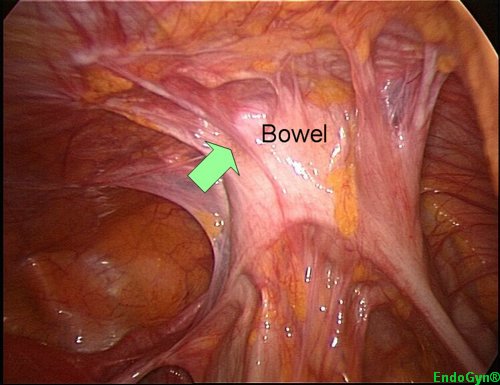
Endometriosis, abdominal surgery, fistula and adhesions…..


Vic has had 81 abdominal surgeries in her life.  Vic’s first abdominal operation was at the age of 10 when she had her first batch of endometrioses surgically removed.

Endometriosis is a gynecological medical condition in which cells from the lining of the uterus (endometrium) appear and flourish outside the uterine cavity, most commonly on the peritoneum which lines the abdominal cavity. The uterine cavity is lined with endometrial cells, which are under the influence of female hormones.

Endometriosis is typically seen during the reproductive years and it has been estimated that endometriosis occurs in roughly 6–10% of women.

About 93%–100% of people undergoing abdominal or pelvic surgery will form adhesions, but luckily most do not have complications of the adhesions.  Adhesions may also result from infectious processes, such as pelvic inflammatory disease.

Abdominal adhesions are bands of fibrous scar tissue that form on organs in the abdomen, causing the organs to stick to one another or to the wall of the abdomen. Scar tissue most commonly develops after abdominal surgery, in which organs are handled by the surgical team and are shifted temporarily from their normal positions. It can also form in people who develop peritonitis, an infection that has spread to the membrane that covers the abdominal organs. Vic has developed peritonitis on numerous occasions.  Peritonitis usually occurs after appendicitis or another abdominal infection such as Vic first developed after her blotched surgery when her small bowel was perforated.  https://tersiaburger.com/2012/10/19/the-albatross/

There is no way to prevent adhesions. Abdominal adhesions can be treated, but they can be a recurring problem. Because surgery is both the cause and the treatment, the problem can keep returning. For example, when surgery is done to remove an intestinal obstruction caused by adhesions, adhesions form again and creates a new obstruction in 11% to 21% of cases.  http://www.intelihealth.com/IH/ihtPrint/WSIHW000/9339/9394.html?hide=t&k=basePrint#prognosis

Fibrous Bands of Adhesion – Bowel obstruction

In most patients, adhesions do not cause health problems. In a small number of people, like Vic, the fibrous bands of scar tissue block the intestines either completely or partially. This blockage is called a bowel obstruction, and it leads to death in about 5% of cases. Sometimes, an area of intestine that is affected by adhesions can keep becoming blocked then unblocked, causing symptoms to come and go. In about 10% of small-bowel obstructions, a portion of the bowel twists tightly around a band of adhesions. This cuts off the normal blood supply to the twisted bowel, causing what is called strangulation, and that section of bowel begins to die. When this emergency happens, the person must be taken to surgery immediately. The death rate is as high as 37% in people who develop strangulation.

Literally meters, of different parts of Vic’s intestines, has been removed.  Every time Vic had an obstruction she had surgery.  Vic has needed skin grafts to cover open wounds.  Vic developed numerous gastrointestinal fistulas.  Due to the extremely thin layer of skin covering her intestines the intestines have chaffed through.  Vic would lose up to 7 liters of feces  per day, through the fistula.

Now we cope with partial obstructions on a weekly basis.  We battle with poor absorption because Vic has lost critical parts of her intestines.  Vic will not have further surgery.  My child has been to hell and back.

No more surgery.

Ready for theater….again…..


“Being prepared to die is one of the greatest secrets of living.” George Lincoln Rockwell


26.6.2012 Before Hospice

Pain at the end of life is inescapably interwoven with, and often amplified by, multiple levels of emotional and spiritual angst as the inevitability of death looms. Fear, a potent pain magnifier, is the dominant emotion – fear of pain, fear of death, fear of the unknown…..

It is a fact that people at the end of life fear pain even more than they fear death. Sadly, for many dying patients, pain seems like the ultimate torment, and death is its cure. It does not have to be this way, and if you or a loved one is facing death, you have every right to ask that your final days not be consumed by pain.

It is estimated that a maximum of 5% of people who die from terminal illness in South Africa have access to adequate palliative care. Even in hospitals, treatment is far from ideal, because doctors and nurses have seldom had training in palliative care and have little idea of what to do with the patients.

Dying patients are often prey to a host of anxieties about the state of their affairs, about the fate of those who will grieve their loss, and about how their behaviour will be seen, and possibly judged, during their final hours. And of course, there are often deep spiritual and religious questions to address. Did my life have meaning? Will my soul survive my body? Am I at peace with myself, my family, and my friends?

Not least of all these concerns, people at the end of life worry about how their pain will be managed. Will they be under medicated and have to ask, or even beg for relief? Will they be over-medicated and lose consciousness during their precious waning days and hours?

They may even be afraid to complain. If they do, will they be seen as whiners or quitters? If they ask for narcotics, will they be judged by their doctors as drug seeking, drug addicts or even cowardly? Or will their medical care be relegated to comfort measures only, while all efforts to cure their illness are suspended?

I read the post of an amazing woman who is suffering from congenital heart failure.  She is in so much pain.  I cried when I read her post.  http://thedrsays.org/2012/11/08/  She replied to a question whether better pain control was possible…..  “there is nothing that will let me participate in life and have relief. so at this point i am going for being lucid over some so-so pain relief. who knows how long before i cave. when the time comes i plan to take advantage of whatever is available to me. just my personal choice right now.”

Vic has received a new lease on life.  Vic has 100% better quality of life since her pain is under control. We discovered, through the expertise of a wonderful palliative care team that Vic’s body did not absorb monstrous quantities of morphine! Now she is not only functioning, she is LIVING!  Vic is more lucid than she was before.

The pain was killing Vic… Palliative care has given her life.

Living life to the full!

 Being prepared to die is one of the greatest secrets of living.   George Lincoln Rockwell 


Is there pain after death?


Andrew, (http://lymphomajourney.wordpress.com ), suffers from mantle cell lymphoma (MCL).  Andrew says “I am a husband, father of a teenage son and daughter, brother, a Canadian government executive with a wide range of international and domestic experience, who likes reading, film, music, walking, cycling, skating, being with family and friends.”  Andrew is a phenomenal source of information.  I sometimes think he has a full-time research team constantly researching all aspects of lymphoma and terminal illness.  I often refer back to his blog.  Please take time to visit his blog.

Andrew posted this earlier today.  You may know that palliative care is my favorite hobbyhorse.  I have fought for my child to have a “good death”.  Thank you Andrew for sharing this article with us!

Is there pain after death?

Posted by  on Oct 5, 2012 in Cancer CareFeaturedLife & Health | 4 comments

Is there pain after death?

A grandfather-father-husband-salesman-cook-gardener-hiker-gentleman, adored by many, is struck down by cancer.  His disease is particularly horrible, spreading quickly though his body causing damage not only to bone and organ, but to sinew and nerve. He suffers terrible pain for weeks, relieved poorly with inadequate doses of inferior medications, thrashing in misery witnessed by his kin, always at the bedside, ages seven to seventy.  Finally, uncomfortable and agitated until the end, he dies.  Does his pain continue after death?

Pain that is not relieved in a person’s life continues after they are gone, held as a sordid memory by loved ones.  Just as we retain treasured thoughts of joy, wisdom and warmth, we preserve images of pain.  Unrequited suffering contaminates memory, preventing healing, healthy grieving and closure. This pain in turn flows across our communities, touching many who may never have met the patient.

This does not have to be somatic discomfort to be treated with pain medication.  Shortness of breath, seizures, nausea, wounds and bleeding cast intense images that last more than one lifetime.  Uncontrolled anxiety or fear may contaminate a family and corrupt its fiber, as can loss of spiritual path, loneliness, or guilt.  Failure to settle past wrongs or mixed intentions results in a loss of opportunity, a psychic wound that will never heal.

A poorly managed end-of-life experience can transform families for generations.  I recently heard of a young man who suffered a miserable protracted death from cancer.  This resulted in his wife becoming chronically depressed and isolated from her family.   She committed suicide, leaving their son a life as an alcoholic and drug addict.  The ripples from that one cancer spread out and, through the network of that family, caused pain for many more.

When we think of end-of-life planning, we focus on those immediate moments for the patient and family, as well we should.  The opportunity to live one’s life well, even at its end, should not be denied, and must be the first goal of palliative medicine and hospice.  However, we cannot overstate the need and potential to protect and even nourish future generations by treating pain of all types in patients with terminal illness, and in families sharing that passage.

There is pain after death, and I suspect it is the cause of much waste, anger and tragedy in our society. We must strive to prevent that suffering.  Good things are possible, loved ones can be together, memories shared, and solid foundations laid. Patients, families, doctors and caregivers must protect and treasure even this difficult time of a person’s life, because as one life ends, others are beginning.  http://sunriserounds.com/?p=920

Sometimes the pain’s too strong to bare…and life gets so hard you just don’t care.


Image

http//www.scientificamerican.com

Today I read heart wrenching posts of bloggers who are in so much pain!  Katie Mitchell’s post filled me with a deep-seated sadness and a horrible, familiar feeling of helplessness.  I am so sad and angry for all the pain out there.

Katie blogs as follows:  Where do I even begin? I am hollow, at my lowest and very near the end of my rope. I’ve been in bone shattering pain now for a week and three days. Not my daily chronic pain, but a pain that is making me lose all faith in ever getting better, or ever surviving long enough to find out. I’m angry at the world and everyone in it, but most of all, I’m angry at a body that is failing me and falling apart.

I’m not suicidal, in fact it’s probably just the very opposite; I’m trying with all that’s left of my strength and going through hell just to live. When I have those thoughts; the ones where I do wish to no longer exist, it’s not because I want to die, it’s because I want need the pain to end.

I’ve been on a much higher dose of my pain meds then I care to be, but even with that I’m barely hanging on. If it weren’t for it though, I would’ve had no alternative but to check myself into the hospital and hope that they would help. I don’t even know if they would do anything for me. The experiences I’ve had with the hospital in relation to pain have never been pleasant or successful. At the most, you get a shot of pain killer and are sent on your way, no thought given to what happens when the medication wears off. Not to mention you’re often treated like a wussy or drug seeker.

My ribs slid back into place about a week ago only to subluxate once again not even 24 hours later. I still can’t bend, can’t breathe deep, dressing myself is a balancing act, showering is difficult and painful. And, I’m scared. Scared that this is a new stage in the progression of my disorder and the deterioration of everything holding my body together. I’m scared that they’re going to stay this way and that I’m going to have to learn to live with this new pain, a pain that made me wonder more than ever how I would ever survive to meet tomorrow. My tailbone is also dislocated or partially dislocated. It’s been doing this sporadically since I was about 10 or so but it’s also very painful none the less.

And then there’s my back. I almost get stuck in my bed everyday when I wake up. Between my ribs and the back pain I can’t sit up to get out of it. Half of the time I’ve been having to roll onto my hands and knees on the floor and struggle up from there. My toes and feet are constantly numb or tingling, my hips and legs are cramping and there’s a constant stabbing pain in my back. I have a doctor appointment on Thursday but I’m considering calling in today to see if they have an earlier opening. I don’t know what to do anymore, I can’t take it. It’s taken me four days of trying, to be able to write this. But I needed to unload and write out some of my thought and feelings. What else am I to do with them?

I’m sad. I’m tired. I have the desire and need to be comforted but am in too much pain to want to be touched. I’m uncomfortable with physical vulnerability but don’t have the energy or will to put on a brave face right now. And then, like I mentioned above; I’m angry and testy but don’t want to take out my pain on anyone that doesn’t deserve it. So, as much as it makes things worse I’ve still been isolating myself.

In the end, pain is a lonely thing.

http://connectivetissuedisorders.wordpress.com/2012/10/01/treading-water

I shivered when I read this post and for a while I was blinded by tears.  I do not cry easily. I reread the post…. How is it possible that one young person can suffer so much pain?

It is a basic human right for chronically ill patients to receive palliative care services while they are receiving life-prolonging or curative treatments…. Why is pain treated with so much disregard by the medical profession?  Is it because people on the other side of the prescription pad are inadequately trained or like me they have never experienced pain?

Doctors are taught that pain is a sign of illness.  In their quest to find and treat the cause, they often neglect to treat the pain.

Vic was treated by the pain clinic for the past five years.  The head of the department is a professor of Anesthesiology.  Vic’s surgeon has been operating on her for the past 10 years and performed at least 60 of her 80 operations.  He knows how little of her intestines are left….  So does the professor.  Yet both these doctors chose to ignore this important factor when managing Vic’s pain.

At best her absorption is extremely poor and we constantly battle malnutrition.  We fluctuate between mechanical obstructions and diarrhoea.  400mg of MST twice per day just accumulates above the heavy fecal loading or is literally being flushed from her system within a very short period of time.  Combine this with severe vomiting bouts…. Often we lose tablets, either end, which is still totally intact…. Maybe the Jurnista worked because it is a slow release tablet that absorbs differently to the MST.

“In simple mechanical obstruction, blockage occurs without vascular compromise. Ingested fluid and food, digestive secretions, and gas accumulate above the obstruction. The proximal bowel distends, and the distal segment collapses. The normal secretory and absorptive functions of the mucosa are depressed, and the bowel wall becomes edematous and congested. Severe intestinal distention is self-perpetuating and progressive, intensifying the peristaltic and secretory derangements and increasing the risks of dehydration and progression to strangulating obstruction.” http://www.merckmanuals.com/professional/gastrointestinal_disorders/acute_abdomen_and_surgical_gastroenterology/

intestinal_obstruction.html#v890928

Now with Hospice the team has realized that her tissue is too poor for subcutaneous morphine, tablets don’t absorb, morphine patches cause skin irritation….Now I administer morphine injections into the skin.  At least the Hospice team is looking for a solution and we have had more good days in two weeks than we had in six months!

In my book every single person is entitled to proper pain management.  In the past, management of chronic pain has often produced unsatisfactory results. For approximately 80% of the world’s population, pain relief when needed, is a right yet to be realized.  One of the chief reasons for this stems from misunderstandings about the pharmacological characteristics of morphine and other opiates.  Furthermore, in an attempt to limit the opium trade, barriers were put into place, to prevent people from accessing pain medications.

Morphine is an opioid.  A psychoactive chemical which has been used for centuries to treat acute pain….

A number of medical schools no longer teach opioid prescribing. Doctors inexperienced in the use of opioids do not know how to initiate, titrate, and withdraw the medication. Faced with undesirable outcomes in patients (e.g., respiratory depression after a rapid increase in dose), physicians have become reluctant to prescribe these medicines. Recent studies have proved conclusively that as long as the patient is in pain they would not develop a psychological dependence on the drug.  It is encouraging that the recent increased interest in the clinical pharmacology of symptom control has demonstrated that it is possible to use morphine safely and effectively, even in patients with advanced disease.

I have seen with Vic that freedom from pain actually prolongs life and allows the body to heal or recuperate.  It is virtually impossible for Vic to die of a morphine overdose even if the dosage is increased substantially.

The human suffering due to lack of pain relief is an affront to human dignity!

In South Africa a large portion of our population is HIV positive.  They live in rural areas where there are no doctors or pharmacies.  If they are lucky there may be a clinic with a nurse….  A doctor’s prescription is needed for morphine.  No doctor = no morphine = painful death.  In syrup form it is cheap!

What a cruel world we live in! When a young girl is fearful of seeking medical help in a first-world country it is truly a disgrace.   “I would’ve had no alternative but to check myself into the hospital and hope that they would help. I don’t even know if they would do anything for me. The experiences I’ve had with the hospital in relation to pain have never been pleasant or successful. At the most, you get a shot of pain killer and are sent on your way, no thought given to what happens when the medication wears off. Not to mention you’re often treated like a wussy or drug seeker.”

I am grateful to the Hospice team!  I am grateful that Vic has been spared further suffering.  We cannot prevent death only unnecessary suffering!

“Sometimes the pain’s too strong to bare…and life gets so hard you just don’t care.  You feel so alone you just sit and cry…every second you wish you could die.  Then you start thinking who would care…if one day they woke up-and you weren’t there.”   Unknown

I would like to list some of the wonderful blogs on pain that I follow slavishly.

http://fullcircledme.wordpress.com/2012/09/20/myths-about-pain-meds-vs-addiction-or-dependence

http://now.tufts.edu/articles/world-hurt-pain

http://ohwhatapain.wordpress.com/being-treated-like-an-addict

http://ohwhatapain.wordpress.com/2012/09/26/flares

http://walkingthroughpain.wordpress.com/2012/09/28/ahhhhhhh/

http://connectivetissuedisorders.wordpress.com/

Hospice Day 11


I wish I had understood Vic’s pain-filled world earlier.  I am so sorry for getting angry with her for trying to live.  I wish we had more time.

via Hospice Day 11.

Hospice Day 11


Last night was an absolute night out of hell.

The subcutaneous syringe driver was halted as Vic’s tissue is so bad.  Vic is now on 100mg Durogesic patches and morphine syrup.  Initially it appeared to be an okay solution.  Then the nausea started…. The pain steadily increased to absolute intolerable levels by last night.

Yesterday morning Vic was great!  She obviously still has some of the intravenous morphine in her system.  (I also gave her extra morphine syrup as a precaution).  She went to breakfast with her friend Angela and had a wonderful time.  She glowed when she got back.  Gill, my BFF, popped in for a cup of tea and was amazed (once again) at how well Vic was looking.  Madam was even wearing a shoe with a little heel (which we made her take off).

In the afternoon Vic started looking grim.  She was nauseous and suffering from abdominal cramping.  Her tummy was distending.

By 10pm last night Vicky was sobbing with pain.  By 11pm she was vomiting uncontrollably.  She has severe intestinal pain and I believe she fractured a vertebra with the vomiting.

This morning I had an early meeting.  Half an hour into the meeting Vic phoned sobbing uncontrollably.  I was unable to hear what she was saying through her sobs.  I just said “Baby, I am on my way…”

When I arrived at home Sr Ciza from Hospice was here.  She had given Vic a morphine injection and an additional 25mg Durogesic patch.  Vic was already looking so much better.  Ciza encouraged me to get a night nurse to assist me… She had written a motivational letter to the medical aid without my knowledge.  I don’t think I am ready for that yet.

Whilst she was vomiting last night I thought of how quickly she “crashes” and how the good times have almost disappeared.  Yesterday morning Angela actually looked at me with a question mark in her eyes when Vic said she wanted to go out for breakfast.  I nodded my “consent”.  You see I had just read a comment from an incredible brave lady.

my husband has expressed the same concerns you have over your daughter pushing too hard when she does feel better. it is so important to me when i do have a good day to get out or make dinner, even doing laundry makes me happy. it is a reminder that i am still me. while i see your point and his, i know how vic feels and know that for me it is worth the price i pay afterward to have that time where i feel like the old me. the me before.  My heart goes out to you all and say a little prayer for your continued wisdom and love. http://thedrsays.org/” 

Today I would also like to quote my “mentor into the world of pain” Tracy Rydzy   http://ohwhatapain.wordpress.com/author/ohwhatapain

The concept of illness as a way of telling you to slow down is frustrating, as I have always lived life in the proverbial fast lane.  Since my first surgery, my life has basically come to a screeching halt.  Any living I do is now in the slow lane, sometimes I never even make it off the shoulder.  I think one of the most difficult aspects of pain, especially during a flare, is the comorbid (I have to use my expensive Master’s Degree vocabulary sometimes) depression and mood swings. 

It’s hard to deal with the slow down.  I mean, generally, this is something that comes with age and is a natural part of life, but when it happens at 33, how the heck do you reconcile that?  Before “all this” I felt so strong.  I felt like I could take on the world.  I used to be busy everyday, all day and the craziness of my schedule was like a high.  Now, I have maybe a quarter of that activity, some days, I have none.  The worst part about slowing down is that the pain slows down my body, but not my mind (thankfully), so in my head I still feel like the woman who can go all day, do it all, run around all day and still have energy left to cook dinner and clean the house.  Nowadays I get up at 1030am on a good day, workout and do maybe one chore, and by the time I am done I want to cry from pain and exhaustion.  But I am still me.  I refuse to let the pain change who I am.

I still feel like I can do it all, but I can’t. The constant drive to push and do more is, at times, a gift and a curse.  I still push  myself to do more, even if it comes with the cost of a day in bed.  When it comes to physical therapy (and the accompanying weight loss), I know that I push myself too far, too often.  That part of my brain that refuses to accept this “new normal” can’t give up certain things.  One thing I can do is physical therapy, so I will do it as hard as I can and push myself, regardless of the cost to my body.  A couple of weeks ago I hurt my back (more) while driving and the surgical nurse, who knows me well by this point, actually said, “I tell most patients to slow down for a little while, but I won’t bother telling you that, I know you won’t.”

Sometimes the slow down causes resentment.  I get angry that those around me have a life and are busy and that adds to the mood swings and depression.  The weekends are the hardest because I want to do so much more than I realistically can, yet I watch friends and family run from event to event with no need to stop and rest.  For me, a trip to Wal-mart requires a rest.

Flares do bring up an interesting realization, though.  Until things get as bad as they are right now, I didn’t realize that I was in less pain before.  So, in essence, flares tell your body to slow down and take it easy, but at the same time, for me at least, it takes something bad to make me realize that before this, I was feeling a little better, at least by comparison.  Now if only I could return to feeling like crap instead of complete crap…

So, the bottom line is, what do you do when life slows you down?  http://ohwhatapain.wordpress.com/2012/09/26/flares

I wish I had understood Vic’s pain-filled world earlier.  I am so sorry for getting angry with her for trying to live.  I wish we had more time.

Hospice counseling….


We met with Alan, the Hospice counselor, today.

On our way to Hospice Jon-Daniel sat with his arms crossed muttering “I don’t need to see anyone” under his breath.  “I am like you Oumie.  We don’t talk…”

Yeah”  I said.  “But I really think the time has come for us to talk to someone.  Besides it is part of the Hospice thing.  We have to do it!”

The whole day I was thinking of shrink jokes” Jared said.  “Do you think I can ask him ‘how does this make you feel?‘”

We all laughed.

Guys if we don’t talk to the counselor we may have to come back…. Let’s answer all the questions and get it over and done with….” I cautioned

Alan is a short young man.  I think he is in his early thirty’s.  We shook hands and he asked us how we wanted to “do it?”

The boys went in on their own.  I sat in the waiting room saying a little prayer that they would open up to this professional stranger who is an expert in dealing with death.  Thirty minutes later I was invited in.

The boys tell me they are coping well.  They don’t see the reason for seeing me…..What do you think?  Are you guys coping?”

I was truly taken aback.  “Yes, I think we are coping.

So Tersia, why do you think the boys need to see me?”

I did not speak for a couple of minutes.  I was grappling with my brain as to how much I should tell this stranger.

I think the emotional roller coaster is getting to us.  We have said our goodbyes so many times and Vic always bounces back!” I eventually said.

“Yes, Jon-Daniel said so” Alan replied.

“I worry that the boys live in a home where death lingers.  There is not enough laughter in our home.  It saddens me when they stand next to their Mom’s bed and I see the helplessness in their eyes!” I mused

“I get impatient with Vic.  When she has half a breath she will organize a party.  When the pain medication works she will not pace herself.  She will hurt herself and  then I have to pick up the pieces.  Sometimes I am scared that her suffering will not end. ” I continued.

What type of party will she organize?” Alan asked.

The boys and I laughed!

“It is only a figure of speech….” we explained.  “She will try and do things with the boys and hurt herself.”

What type of things?” Alan asked

Drive and take us for a milkshake” Jared replied.

“Mom forgets things and she thinks we are all against her…  Yesterday she said to me that I must not feel guilty if she dies and I am cross with her…Mom always thinks we are fighting with her….” Jon-Daniel said.

It is not about the final moments.  It is not the final words or even the final disagreement.  It is about the life and all the years of loving before death and dying…. You must not ever blame yourself for anything.  Life is hard for all of you right now.  It is okay to be scared and to get irritated.  You must tell your Mom how you feel.  I am not saying you must back-chat.  What I am saying is that you must tell your Mom how her actions and illness makes you feel.  The household consists of more than one person…. You all have the right to living…”

The boys asked to see Alan for another session….  Thank you God for another angel!


Mommy, I thought I had more time….


“You matter because of who you are. You matter to the last moment of your life, and we will do all we can , not only to help you die peacefully, but also to live until you die.”

–Dame Cicely Saunders

Mommy, I thought I had more time…..

Mommy, I thought I had more time….


Jared and his proud mommy

“You matter because of who you are. You matter to the last moment of your life, and we will do all we can , not only to help you die peacefully, but also to live until you die.”  –Dame Cicely Saunders

The Hospice doctor that called to see and evaluate Vic was a tall, slim young woman.  She has a gentle voice and long fingers with short nails.  She drives a Jeep and keeps large dogs.  She looks like a naturalist.

“I am Dr Sue Walters from Hospice.  The Pain Clinic asked us to see you.  Is it okay for me to examine you?” she asked Vic in her gentle voice.

Vic’s abdomen was severely distended and very tender.  She was running a fever and her resting heart rate of 103 indicating severe pain despite the fact that she had already taken her pain medication.  Vicky’s vitals were poor.

Sue administered a strong morphine injection.

“Vicky, you appear to have an abscess on the right-hand side of your abdomen.  The skin is hot to the touch and distended.  I think you have a partial obstruction.” Dr Sue said to Vic.

“I am here to see if Hospice can help you.  Do you realize that you are very ill my love?”  Dr Sue asked Vic.

“Hospice will not hasten your death my love.  It would be our aim and purpose to provide you with pain relief and quality of life.  We will treat you and not the disease.  It is exclusively your decision whether you want us to help you and how you want us to help you.”  She explained to Vic

Hospice is a philosophy of care. The hospice philosophy or viewpoint accepts death as the final stage of life. The goal of hospice is to help patients live their last days as alert and pain-free as possible. Hospice care tries to manage symptoms so that a person’s last days may be spent with dignity and quality, surrounded by their loved ones. Hospice affirms life and neither hastens nor postpones death. Hospice care treats the person rather than the disease; it focuses on quality rather than length of life. Hospice care is family-centered — it includes the patient and the family in making decisions. http://www.cancer.org/Treatment/FindingandPayingforTreatment/ChoosingYourTreatmentTeam/HospiceCare/hospice-care-what-is-hospice-care

Vic was in so much pain that she was barely able to speak.  Tears welled up in her eyes and she softly said “Please doctor”.

“My love, you need to tell us how you want us to treat your symptoms such as obstructions?” Dr Sue asked

“I want no life extending treatment.  I am so tired doctor” Vic whispered.  “I can’t do this anymore…..”

“That’s fine my love.  We will try and relieve your pain and give you some quality of life.”

“Mommy I thought I had more time…” Vic said with tears silently running down her cheeks…… Then the injection kicked in and she drifted off to sleep.

Dr Sue said that the responsible sister would collect the morphine from the Hospice pharmacy and she would set up a  subcutaneous morphine syringe system by that afternoon.  Hospice would arrange for counseling for the boys.

She hugged me and left.  All of a sudden I felt so alone again!

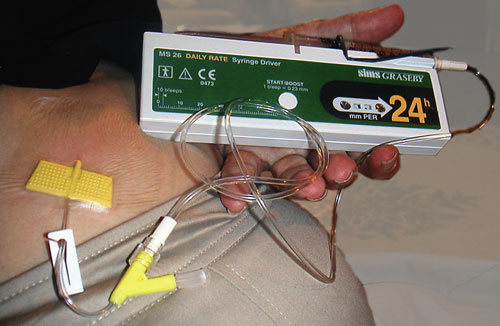
Subcutaneous, or under-the-skin, injections use a needle to deliver medications into tissue just under the skin. An infusion of morphine, anti-nausea medication and Dormicum is now administered 24/7.

The first couple of days Vic slept a lot.  She was tired but there was immediate pain relief.

The nausea subsided and the partial obstruction cleared two days later!

The first infusion site was in her leg.  Within a day and a half the area “tissued”.   A common side effect associated with subcutaneous injections is injection-site reaction such as swelling, redness, and pain.  We phoned Hospice and the Nurse promptly came and the needle was reinserted into the arm.  Within two hours the needle came out again and the morphine was running onto the skin.  It was too late for the Hospice Nurse to return and to re-insert the needle so Vic went to the doctor and he relocated the needle into the abdominal area.

Last night the tissue in the abdominal area had tissued again.  It was also bloody and the morphine was running onto the skin and not into the tissue.  Vic was nauseous with pain.  I had no option but to remove the needle and re-inserting it into a different site.

“I think we should put it into the other side of your tummy” I said

“Mommy, I will insert the needle if you help me…” Vic replied

“No sweetie” I said.  “I will do it”

My heart was in my throat.  I removed the needle and cleaned the injection site.  I disinfected the new site that I had identified.  I took the needle in my hand and lifted the skin.  I pushed the needle against the skin.  I assumed that the needle would just slide in… It did not just slide in!  There was resistance!! I let go of the skin and changed my position.  I could hear and feel my heart pounding in my ears! I again took my child’s skin between my fingers and pulled it upward.

“Maybe I should relax my hold onto the skin…maybe the skin must more relaxed?…..” I thought.

I exerted pressure on the needle and it slid in…  Sweet success!!!!

“Oh Mommy you are such a star!  Thank you.  That did not hurt at all!” Vic gushed.

I do not believe her.  I had felt her little body tense up as the needle went in.  It hurt!

My entire body shook.  The bile rose in my throat and I slowly let out my breath.

We have all come such a far way.  Until last night I could not watch anyone stick a needle into my child.  Now I have stuck a needle into my child’s flesh.  I fear that Vicky’s tissue is too poor for us to continue on the subcutaneous route…… If we do I will have to do this many more times in my life.

The good news is that I was actually able to work the whole week.  It was the annual African Air and Defense Show and we exhibited.  Normally I would be absolutely frantic about Vic.  But I was okay with the fact that she is relatively pain free and the nursing sister visits every two days.

Vic is far more active.  She is truly so much better.  The partial obstruction appears to have cleared!  She spends time chatting to the boys.  On Saturday she took Jared shopping for a new shirt and shoes!

On Sunday morning Jared lit candles “For those we have loved and lost but will forever be in our memories♥..Gramps, Oupa Tienie, Ouma, Nan and Oupes♡”  Vic handed him his baptism candle that she received 15.5 years ago at his christening.  He lit his candle as he took responsibility for his own walk with God.  Vic and I laid hands on him and prayed for him.  It was so touching.

Joyous day!

Vic attended Jared’s confirmation service.  I have never seen a more radiant and proud mother in my entire life.

Vic has reached another milestone in her life.

Pain keeps you alive!


She explained to us that Vic’s pain is what is keeping her alive.  ”An adrenaline rush is the fight or flight response of the adrenal gland, in which it releases adrenaline (epinephrine). When releasing adrenaline, one’s body releases dopamine which can act as a natural pain killer. An adrenaline rush causes the muscles to perform respiration at an increased rate improving strength. It also works with the nervous system to interpret impulses that trigger selective glands.”  http://en.wikipedia.org/wiki/Adrenaline_Rush

via Pain keeps you alive!.

Pain keeps you alive!


Vic has been accepted into the Hospice program.  The doctor evaluated her at 07h00 this morning and immediately gave her a strong pain-injection.  She also put on a 75mg Durogesic patch.  Vic will remain at home.  We now have access to nursing professionals 24/7.  A subcutaneous infusion will be set up this afternoon for the administration of all further pain medication .  Vic will no longer drink any tablets.

Vic has a partial obstruction and an abscess in the abdomen.

The continuous subcutaneous infusion of drugs by a small portable pump (sometimes called a “syringe driver”) is a major advance in terminal care, particularly for symptom control in the home. It has a number of advantages over intravenous therapy. It is safer (much less risk of infection and no risk of air embolus). The patient can remain fully ambulant. Tolerance does not develop to subcutaneous morphine as it does occasionally to IV morphine. (see Morphine)

The main indications for continuous subcutaneous infusions are vomiting, dysphagia, severe weakness or unconsciousness. They can be particularly useful for patients at home, either to control nausea and vomiting, or during the last days of life if the patient is no longer managing oral medication.

A continuous subcutaneous infusion of drugs is particularly useful in the management of malignant intestinal obstruction. (see Intestinal Obstruction)       http://www.hospiceworld.org/book/subcutaneous-infusions.htm

In the words of Dr Sue Walter, MBBCH/PALLIATIVE MEDICINE, “Vic’s suffering is inhumane”.

She explained to us that Vic’s pain is what is keeping her alive.  “An adrenaline rush is the fight or flight response of the adrenal gland, in which it releases adrenaline (epinephrine). When releasing adrenaline, one’s body releases dopamine which can act as a natural pain killer. An adrenaline rush causes the muscles to perform respiration at an increased rate improving strength. It also works with the nervous system to interpret impulses that trigger selective glands.”  http://en.wikipedia.org/wiki/Adrenaline_Rush

Maybe this is the final part of Vic’s journey.  I do however expect her to bounce back!

Syringe driver


September and awareness of pain


As a mother of a terminally ill child, who suffers debilitating chronic pain, I have researched pain extensively.  I have argued with physicians and meet with pain specialists at the pain clinic every month.  I have bullied hospital nursing staff.  I have witnessed and lived my child screaming like a wounded animal from pain….. Doctors telling her that she is a morphine addict and pharmacists double-checking and verifying Vic’s scripts…  

September and awareness of pain.


September and awareness of pain


The month of September is dedicated to help bring awareness to a very much misunderstood disease, Chronic Pain (C/P). In the USA, Chronic Pain has finally been inducted by the American Medical Association as a disease, with its own diagnostic code even though it encompasses multiple over-lapping conditions and diseases.

As a mother of a terminally ill child, who suffers debilitating chronic pain, I have researched pain extensively.  I have argue
d with physicians and meet with pain specialists at the pain clinic every month.  I have bullied hospital nursing staff.  I have witnessed and lived my child screaming like a wounded animal from pain….. Doctors telling her that she is a morphine addict and pharmacists double-checking and verifying Vic’s scripts…

Yet the levels of Vic’s pain force us to eat humble pie.  We have to go back time after time asking and even begging for pain medication.

Tracy at http://ohwhatapain.wordpress.com/ is a passionate advocate bringing awareness about this chronic illness, and this month she has a special project. Please visit Tracy’s blog. Even if you are not directly involved chances are there is someone in your life that is.  I have a headache (maybe) once a year.  I never have a tummy ache, earache, toe-ache or any ache as a matter of fact.  Yet I am a specialist on the subject of pain…  I will therefore participate as a caregiver of someone who suffers debilitating chronic pain…..

So from Tracy’s Blog this month and all month-long;

 Please answer the following questions:

  1. What condition(s) do you have that have led you to living with chronic pain?

Vic has a frozen abdomen, Osteogenesis Imperfecta, Addisons Disease and severe Endometriosis.

  • Frozen abdomen,” is a condition  in which repeat surgeries to remove the fibrous bands create so much internal scar tissue that further surgical intervention becomes dangerous. Inflammatory conditions like appendicitis, internal infections and abdominal surgeries can cause the abdominal tissues to bind together, forming scars.  Adhesion formation in the abdominal or pelvic cavity can cause debilitating pain, nausea, vomiting, cramping. Patients with intestinal obstruction may experience constipation, diarrhea or a combination of both. In severe cases, adhesions can cause intestinal obstruction, bowel strangulation, complications with childbirth and infertility.
  • Osteogenesis Imperfecta (OI) is a genetic bone disorder characterized by fragile bones that break easily. It is also known as “brittle bone disease.” The term literally means “bone that is imperfectly made from the beginning of life.” A person is born with this disorder and is affected throughout his or her lifetime. http://www.oif.org

The condition arises from problems with the adrenal gland itself, a state referred to as “primary adrenal insufficiency”, and can be caused by damage by the body’s own immune system, certain infections or various rarer causes. Addison’s disease is also known as chronic primary adrenocortical insufficiency, to distinguish it from acute primary adrenocortical insufficiency, most often caused by Waterhouse-Friderichsen syndrome. Addison’s disease should also be distinguished from secondary and tertiary adrenal insufficiency, which are caused by deficiency of ACTH (produced by the pituitary gland) and CRH (produced by the hypothalamus), respectively. Despite this distinction, Addisonian crises can happen in all forms of adrenal insufficiency.

  • Endometriosis A major symptom of endometriosis is recurring pelvic pain. The pain can be mild           to severe cramping that occurs on both sides of the pelvis, in the lower back and rectal area, and   even down the legs. The amount of pain a woman feels correlates poorly with the extent or stage      (1 through 4) of endometriosis, with some women having little or no pain despite having extensive            endometriosis or endometriosis with scarring, while other women may have severe pain even           though they have only a few small areas of endometriosis. Throbbing, gnawing, and dragging pain             to the legs are reported more commonly by women with endometriosis.[4] Compared with women with superficial endometriosis, those with deep disease appear to be more likely to report shooting        rectal pain and a sense of their insides being pulled down.[citation needed] Individual pain areas and     pain intensity appears to be unrelated to the surgical diagnosis, and the area of pain unrelated to area of endometriosis.[citation needed]

Endometriosis lesions react to hormonal stimulation and may “bleed” at the time of menstruation. The blood accumulates locally, causes swelling, and triggers inflammatory responses with the activation of cytokines. This process may cause pain. Pain can also occur from adhesions (internal scar tissue) binding internal organs to each other, causing organ dislocation. Fallopian tubes, ovaries, the uterus, the bowels, and the bladder can be bound together in ways that are painful on a daily basis, not just during menstrual periods.[citation needed]

Also, endometriotic lesions can develop their own nerve supply, thereby creating a direct and two-way interaction between lesions and the central nervous system, potentially producing a variety of individual differences in pain that can, in some women, become independent of the disease itself.[2] http:

 2. What do you want others to know about what it’s like to live with chronic pain? (i.e.- what is it no one is saying about life with chronic pain? )

Vic has lost her spontaneity.  She has to plan every single outing well in advance whether it is a trip to the hairdresser or the doctor, watching Jon-Daniel play cricket or having a cup of coffee with a friend.  Vic has lost her ability to live.  She merely breathes.

3. Which philosophy do you ascribe to:  Keep hoping that the pain will get better or learn to adapt to life with chronic pain?

Both.

4. What do you miss the most that you feel you gave up because of chronic pain?  What do you do now to fill that void?

Playing with her boys…. Vic was never able to play ball or “touches” with the boys.  Vic spent a lot of time reading to the boys when they were younger.  Now her health and pain is at levels that prohibits any compensatory actions.

 5. What have you heard from others that made you feel better? 

“It is okay to give up….”

 6. Do you feel that people view/treat you differently? How?

People get tired of hanging around people who are always ill and in pain.  They avoid Vic.  The average person does not know how to handle her raw pain and they are scared that pain or “bad luck” is contagious.  Vicky is viewed as someone who is past her “sell by” date.

 7. What coping mechanisms have you tried that worked for you?  Which ones did not work for you? (Traditional and Non-traditional)

Vic used breathing techniques earlier in the diseases timeline.  Now it is too painful.  When Vic has a good day she will do something extravagant like pick the boys up from school and take them for a milkshake.  It allows her for a brief moment to believe that her life is normal.  It is a form of a coping mechanism.  Living the moment and pretending that her life is “normal”

Related articles


“How to Die In Oregon”


“How to Die In Oregon”.