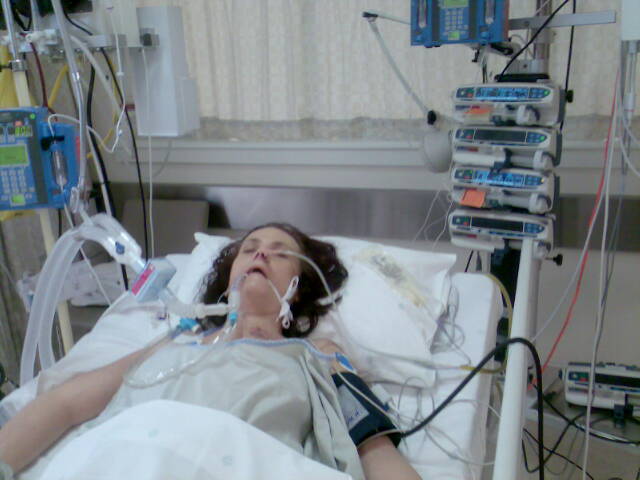
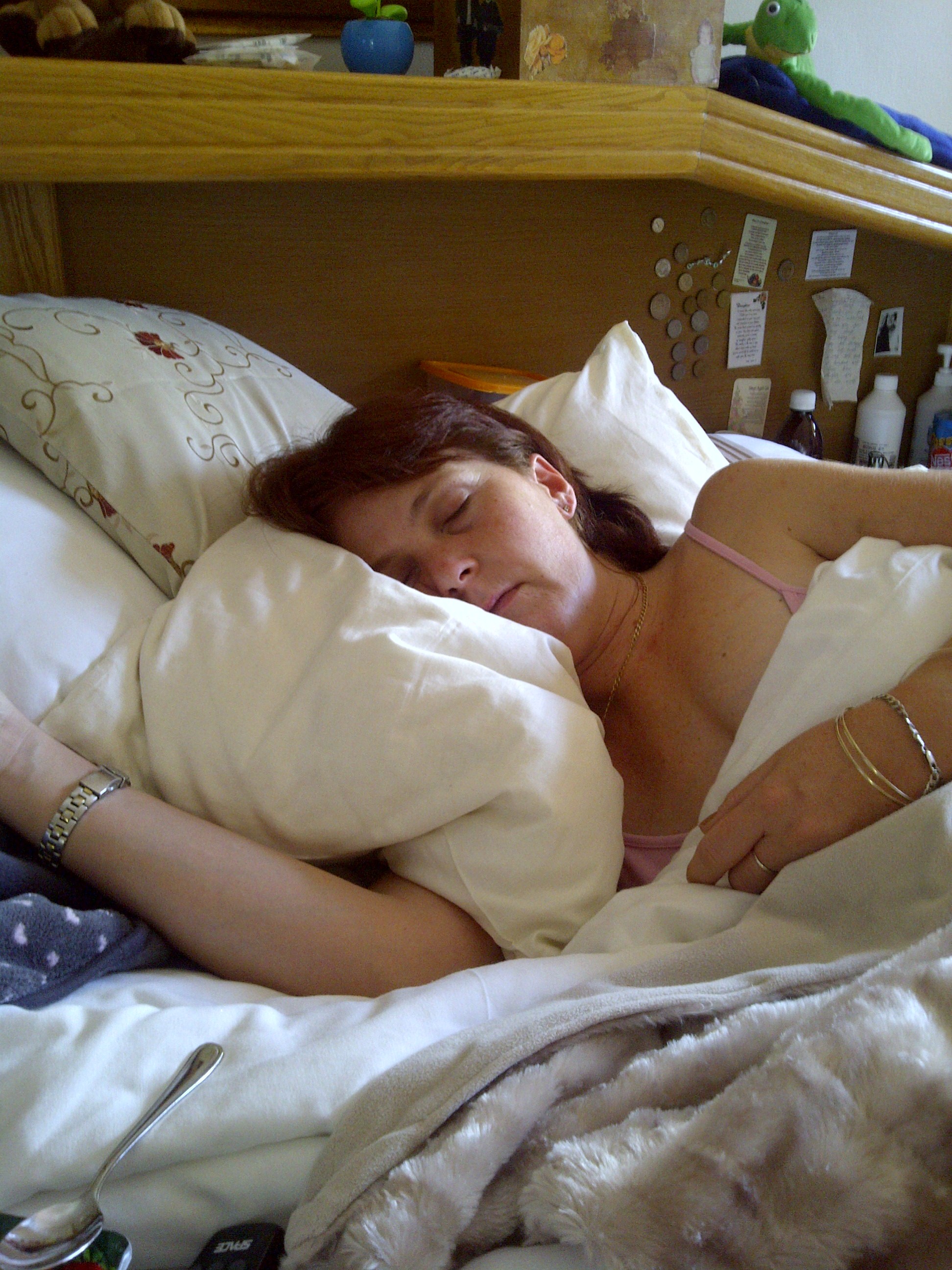
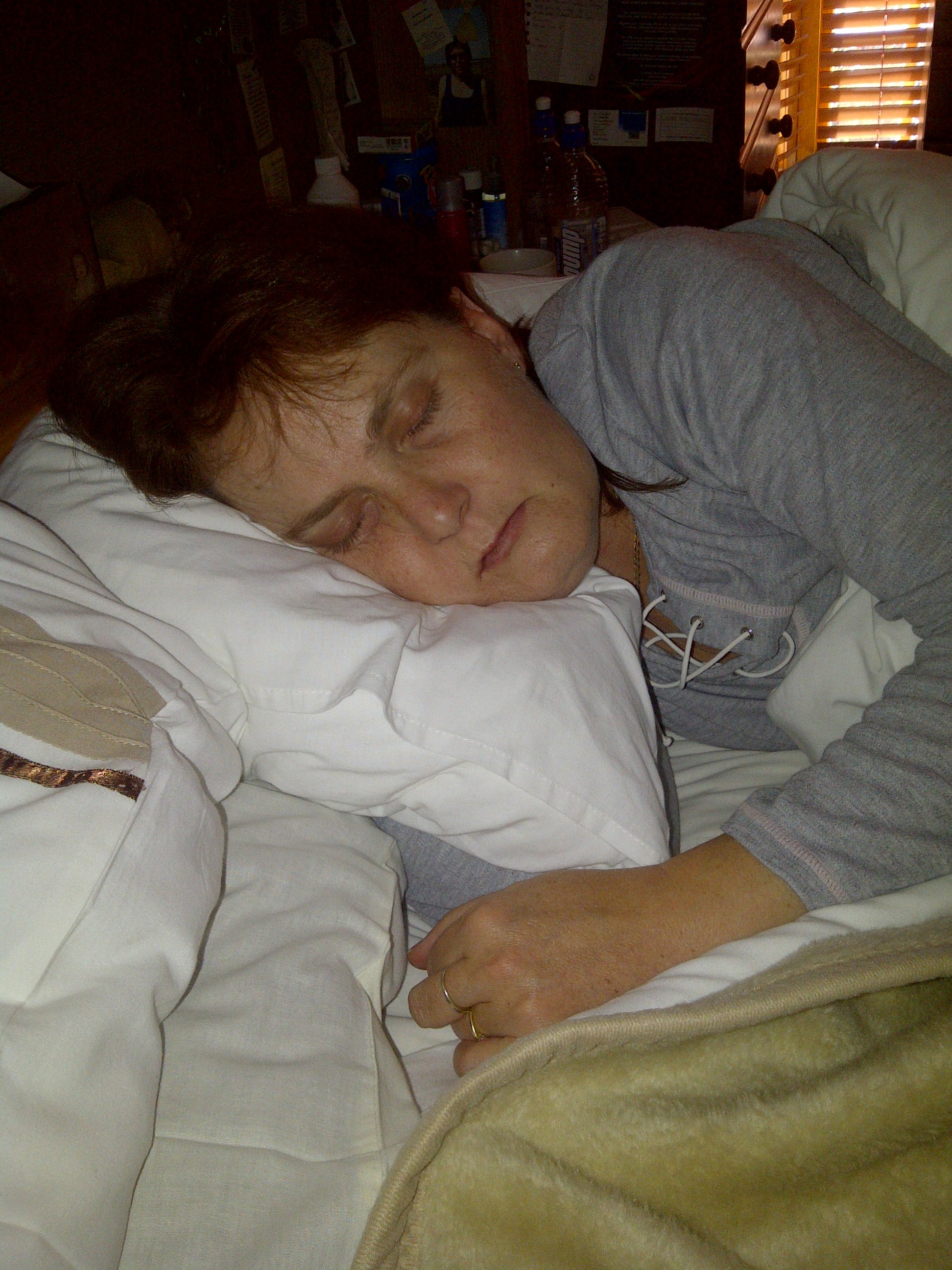
We both laughed and the moment was over…


Vic 25.6.2012

Last night was a better night.  The additional anti-nausea injections are working.   I hope the antibiotics are working.

Hospice measured Vic’s SP02 levels today and it is between 84 and 88%.  I don’t think that is a good sign.  Lani, second eldest stepdaughter, phoned me last night and told me that she had chronic ill patients whose SP02 levels were as low as 70%.  Lani is a physiotherapist.  I felt better after our chat.

Vic is extremely tired.  She went out for coffee with her best friend, who, very recently, was diagnosed with breast cancer.  Vic is a compassionate and caring person and wanted to support her friend emotionally!  When she got home she had a lie down – for the rest of the day.

Tonight I helped her bath and wash her hair.  Poor poppet, she is so exhausted after her bath that she had to lie down and is taking a nap again.  Her hair is still damp but we will dry it later.  I hope she has a better night but I am not very optimistic.

Whilst I was rinsing Vic’s hair she said “Mommy what do people do that don’t have a family like mine”

“Oh sweetie, it must be very hard for them…”

“Sometimes I feel guilty because I take up so much time, money and attention from you.  I have taken up your entire life…” Vic said

“But sweetie, we love you!  What do you want us to do less for you to feel better?  Tell me and we will do it!”

We both laughed and the moment was over…

A while back I made a decision.  We do not have our own Hospice in our suburb.  We fall under the auspices of the Houghton (Johannesburg) and are literally the orphans of the system.  I am going to start a Hospice in Alberton.

This Hospice will focus on palliative care and will bring purpose to Vic’s suffering.  It will be a monument of her suffering and her compassionate nature.


An end of life discussion is one of the most important things to do right


An end of life discussion is one of the most important things to do right.

An end of life discussion is one of the most important things to do right


Vic July 2007

This is a subject very dear to my heart.  Vic has been saved from the claws of death so many times in her little life.  I often lie in bed thinking how much physical pain and discomfort I have imposed on Vic by not allowing the doctors to not give up.  By cajoling her into living.  Twice this week I begged her to allow me to take her to hospital.  I promised earlier this year that I would respect her wishes. https://tersiaburger.com/2012/05/18/6-5-2012-3/   

My BFF, Gillian, sent me this email message:

Morning, you summed up “Where did the time go” perfectly. I cannot believe that 8 years have passed so quickly. Jon Daniel was 7 and Dr said he would not understand about death, but Jared 9 would be able to comprehend and mourn. You wonder what is better……. When they are little or older. Vic our miracle child has hung in there for her Angels. She can only be commended on her will power to add another day to their lives. She has no life. Except to smile with sad eyes every time she sees the boys for another day. As hard as it is to nurse your child, you are also spared Another day good bad or ugly. God has sent Vic to us give each one a lesson – not to complain or give up – the Power of the mind. Be grateful for what we have body mind and soul. Love you all with all my heart

What Gillian wrote in her mail is so true.  If I had allowed Vic to die earlier she would of been saved incredible amounts of raw, undiluted suffering and indignity!  A couple of posts ago I wanted to include a photo of Vic’s abdomen so people could understand what a person looks like after 81 abdominal surgeries.  I decided against it as it is too horrific to post.  But we have been blessed with some wonderful times.  The boys are now old enough to understand the extent of her suffering.  At this stage I am focused on her pain.  I remember when I was stressed that she was taking a couple of hundred milligrams of morphine a week.  Now it is a couple of hundred per day…

Reblogged from http://www.kevinmd.com/blog/2012/11/life-discussion-important.html by  on November 11th, 2012 in PHYSICIAN.  I read this on Andrew’s blog  on http://lymphomajourney.wordpress.com/2012/11/15/an-end-of-life-discussion-is-one-of-the-most-important-to-do-right/

During an internal medicine residency, newly hatched doctors are responsible for some of the sickest patients in their teaching hospitals. This is because those patients often don’t have private doctors to attend them and are poor and sometimes self abusive, with the complex problems that go with smoking, drug and alcohol abuse and lack of regular medical care. These patients often present with their diseases late in game, when much must be done quickly.

There is little or no time to discuss end of life issues and so the assumption is made that these folks want “everything done” which includes machines and potions to support organs and bodily functions as they cease to work right. A scenario might look like this: 48 year old heroin abuser comes in with fever of 104 and symptoms of a stroke. He is admitted to the intensive care unit with low blood pressure, becomes gradually delirious and his heart rate increases, he is sedated for trying to crawl out of bed and run off, he becomes lethargic and is unable to breathe for himself, a central line is inserted and he is intubated and put on a ventilator, his blood pressure is supported with pressors and fluids, his oxygen level cannot be supported despite high ventilator settings. His kidneys cease to work and his heart goes into a rhythm that produces no blood pressure at all, he receives CPR with chest compressions, he is resuscitated, but barely alive, unable to communicate, obviously brain damaged beyond repair, placed on dialysis, eventually succumbs to overwhelming infection. We call this a “flail.”  It is horrifying and time consuming and ultimately a colossal waste of human and monetary resources. Repeated experiences of this type sour most of us on the idea of being resuscitated, so many doctors consider themselves “DNR (do not resuscitate).” We don’t want to be resuscitated ever, no matter what. There are some things that are worse than death.

Some resuscitations go well, though. A patient arrives in the emergency department with chest pain, develops an arrhythmia, has chest compressions briefly and electrical cardioversion and is conscious within minutes or hours. Some people briefly can’t support their own needs for respiration and require a few days of ventilation before being able to breathe adequately. Although they are weak and puny for awhile, they go home and live to tell the story, go back to work, raise families, climb mountains. These successes usually happen to people who were vital before they became really sick, the younger folks, without multiple or terminal illnesses to begin with.

When someone is admitted to the hospital, the physician responsible for their care (which is more and more often the hospitalist) determines, if possible what their wishes would be regarding life support should their breathing or heart stop. These discussions are very difficult if the patient has not thought about resuscitation and has not talked with a physician who knows them about options.

Often patients have reasonable hesitance to make potentially life determining decisions with a doctor who they don’t know and who doesn’t have time to talk with them about the implications of these decisions. In our heads we have a pretty good idea of which patients would do well should they require cardiopulmonary resuscitation, and we really want people whose chances of recovery are lousy to tell us that they are DNR. A DNR decision means that will not flail them. We will not get into a situation in which failure is likely. Should this patient become so sick that medicines, hydration and appropriate surgical procedures cannot save them, we will transition to a strategy that makes death peaceful and painless.

We rarely succeed in communicating this to patients and many who will not benefit from cardiopulmonary resuscitation say “Oh yes, doctor, I want everything done.” Some say this because their experiences are different from ours, they have seen doctor shows in which resuscitation was successful, they think that withholding resuscitation means getting substandard care, and sometimes they think that we just want to spare ourselves the trouble of saving them. And some of these concerns are valid. A patient who is “DNR” may not be watched as closely or treated as quickly if they decompensate. Some people with horrible prognoses do get better after being resuscitated, though this is pretty uncommon and usually involves a pretty significant decrement in quality of life.

Even though it is hard to establish trust with patients or their families in the context of being a hospitalist, I think it is one of the most important discussions to do right. It is everso tricky, though. Even asking the question can make a patient frightened or hostile. They wonder if we are asking this question because we secretly think they are going to die soon. They feel that the subject is too private to broach with a near stranger. They have never thought about it and don’t want to start now. They think that if they make a decision not to be resuscitated that their family members will think that they don’t love them.

But sometimes patients have been waiting, oh so patiently, for someone to bring up the subject and be willing to take enough time to answer the questions that they have been afraid to ask. I find that a discussion of resuscitation is best started after I learn about who a patient is and what they have done for a living and what they spend their time doing at home. What were they good at when they worked? Do they have kids or grandkids? Where do they live, do they travel, do art, take care of other people, have pets? It is hard or impossible to help a person navigate the end of life if I don’t know them.

Even though I am a bit biased against intensive and technological medical care, I love actually doing it. The tools of this trade are really clever and the immediacy of the practice is inspiring and brings people together. I have seen beautiful and compassionate intensive care, which makes patients and families feel valued. Nevertheless, there are always the unintentional and casual cruelties of disturbed sleep, needles, boredom, prickly heat, bowel indignities, physical pain and nausea. Death following chest compressions and electrical cardioversion is not peaceful.

When I sit with a person and hear that, no, they don’t want intensive care or cardiopulmonary resuscitation should their heart or lungs cease to work, and it is clear that resuscitation is not in their best interest, my heart feels lighter. I can focus more on what the patient values rather than what procedures are most likely to keep them alive for the longest time.

Janice Boughton is a physician who blogs at Why is American health care so expensive?
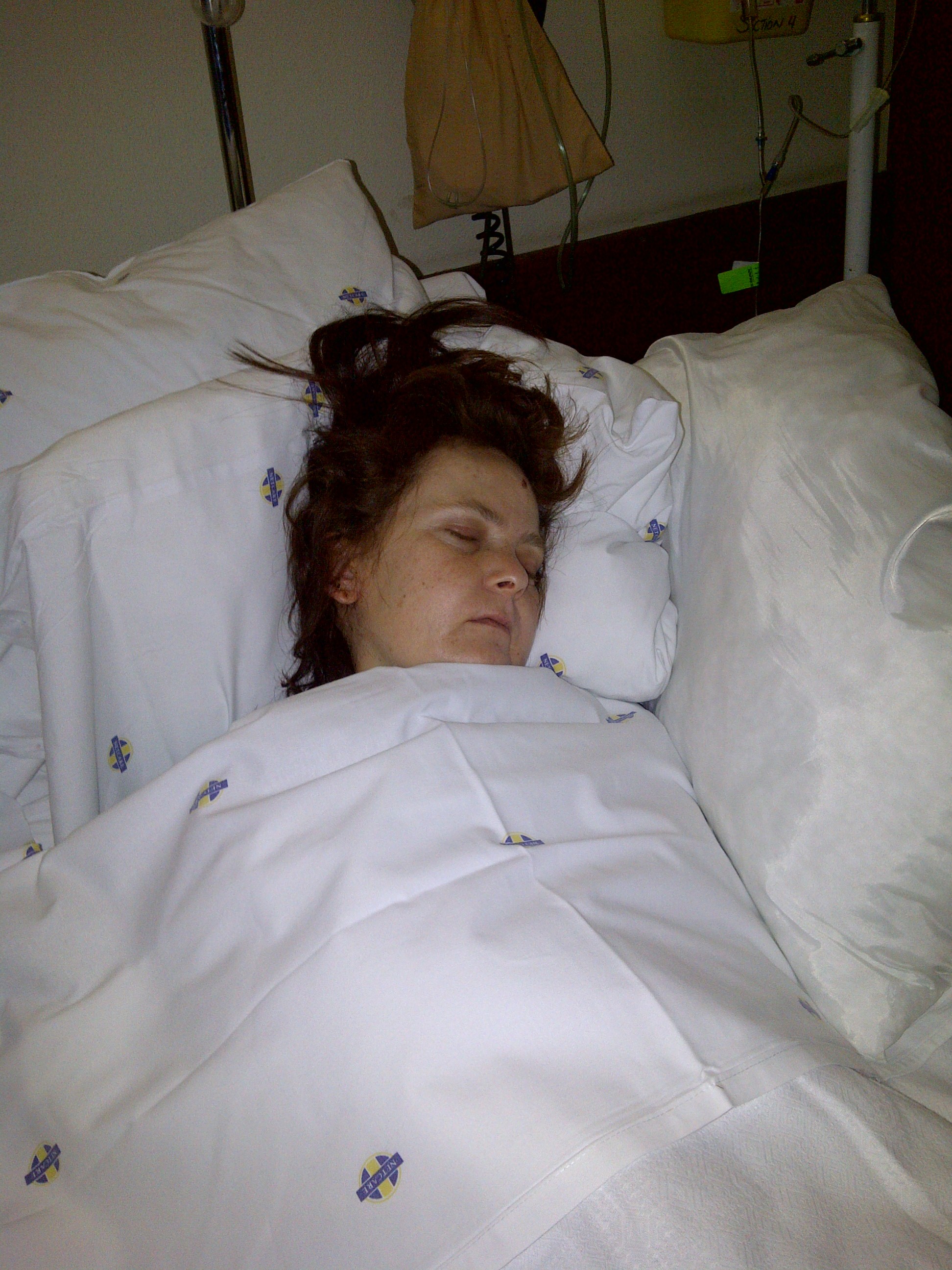
A night out of hell


Vic had a night out of hell!  The nausea was vicious and unrelenting.  Pain reduced Vic to a whimpering bundle of human flesh.

Vic’s palliative Care physician, Dr Sue, visited Vic this morning.  I think she was a little taken aback by Vic’s condition.

Sue is an amazing person.  She was so gentle with Vic.  Vic’s heart rate is fast and her blood pressure is 101/58.  Vic has a bronchial infection, her liver is taking severe strain and the sepsis has flared up – badly.  Her oxygen saturation levels are low – 90%.

Sue gently explained that although Vic is running a fever her body’s “warning systems” have started shutting down….. Vic is very warm to the touch yet the thermometer only reflects a temperature of 36.8⁰.

I asked her what I was doing wrong because sometimes, when I inject Vic and withdraw the needle, blood and/or the injection fluid spews out!  Sue explained that it because Vic’s collagen is so poor…. In layman’s terms; the flesh does not “seal” when I extract the needle….  That is why the subcutaneous syringe driver did not work and blood and whatever else spews out.

Vic is such as gentle, beautiful, caring human being.  Last night when I gave her an additional morphine injection, in desperation, she said “Mommy, what do poor people do who have no access to pain medication?

As a layman with access to Google I Googled “low oxygen saturation” and nearly had a heart attack of my own.

Basically, a saturation of 97% of the total amount of hemoglobin in the body is filled with oxygen molecules. A range of 96% to 100% is generally considered normal. Anything below 90% could quickly lead to life-threatening complications. The margin between “healthy” saturation levels (95-98%) and respiratory failure (usually 85-90%) is narrow. If oxyhemoglobin is low (below 90%) inadequate amounts of oxygen will reach body cells!

As a rule of thumb, respiratory failure usually occurs when saturation (SpO2) falls to 90%, although some patients with chronic respiratory disease may tolerate lower saturations. http://www.favoriteplus.com/oxygen-saturation.php

Every time your blood oxygen level falls below 92% saturation your body suffers drastic consequences Insufficient oxygen level is an immediately life threatening issue. http://www.heartfailuresolutions.com/34/oxygen/low-oxygen-levels-how-low-is-too-low-and-should-you-worry

By tomorrow afternoon we should start getting the results in from the blood tests and blood gases.  In the interim Sue has increased the amount of intravenous anti-nausea medication as well as the pain medication.  Dr Sue will make a call tomorrow whether Vic should go onto oxygen or not.

We have cancelled all our vacation plans.  We desperately wanted to take the boys away for a couple of days to give them a break, but it is not possible.  We will have the best Christmas ever.  A Christmas filled with love and togetherness….  Maybe our last.


Life is’nt about keeping score


Add your thoughts here… (optional)

drbillwooten's avatarDr Bill Wooten

“Life isn’t about keeping score.
It’s not about how many friends you have
Or how accepted you are.
Not about if you have plans this weekend or if you’re alone.
It isn’t about who you’re dating,
who you used to date,
how many people you’ve dated,
or if you haven’t been with anyone at all.
It isn’t about who you have kissed,
It’s not about sex.
It isn’t about who your family is or how much money they have
or what kind of car you drive.
or where you are sent to school.
It’s not about how beautiful or ugly you are
or what clothes you wear,
what shoes you have on,
or what kind of music you listen to.
It’s not about if your hair is blonde, red, black, or brown
or if your skin is too light or too dark.
Not about what grades you get,
how smart…

View original post 199 more words

Signposts for Dying


Yesterday I posted on “time”.  Today after the visit from the Hospice sister I actually realized that just maybe Vic has entered the first stages of dying 

Some of the stages of dying start to be discernible a few months before death occurs.  

 Vic has become less active; she rests more, sleeps more and has withdrawn into her own inner realm. 

 Vic is reliving memories and spends a lot of her awake time talking to the boys about her childhood, her “illustrious” school career and their childhoods.  This year she relived every minute of her father’s final journey… Vic has started living in the past.  

 I read that it is the terminally ill’s way of taking stock of their lives and making their peace with it.

 Vic no longer eats big meals and I seldom hear her say “I am ravenous”.  Due to the 81 abdominal surgeries and multiple bouts of septicemia  Vic’s absorption is very poor.  (Poor absorption = BIG appetite!)  Vic used to have the appetite of a horse – always nibbling and scrounging for food.  Now it is sheer discipline that keeps her eating.  She knows she cannot have medication without eating first.  Strange thing is that she is not really losing weight.  Hospice says it is due to the high levels of cortisone she takes…  I have been told by Hospice not to worry about her loss of appetite.  Her body does not need a lot of fuel (food) anymore because it is not burning a lot of energy anymore….

 The effect of the reduced food and liquid intake is that the body starts producing chemicals that create a feeling of mild euphoria.  Our bodies actually start relaxing into this stage of dying. 

 Vic still drinks a fair amount of coffee.  She used to drink it warm but now she dozes off before she has finished her cup of coffee.  She will wake up and take a sip of cold coffee… A cup of coffee now lasts a long time.

Vic spends the majority of the day in bed, gently dozing…. It is not a deep sleep.  It is as if her little body is preparing to hibernate….preparing for what lies beyond death whether it is Heaven, Nirvana or the Other Side…. 

 Reduced appetite and increased sleep is called “Signposts for dying”.

 A couple of weeks ago Vic was very emotional.  She would tear up without any reason.  This stage has passed.  It is as if her tears cleansed her soul. 

 Vic is battling with loneliness.  She hates being alone.  If she could she would have one of us around her all the time.  She often complains that we do not spend time with her.  We do spend a lot of time with her.  She just dozes off and then we leave to carry on with our lives…  The boys are writing exams – they have to study; I have to work…. Dying is a lonely journey

 Vic is not in good shape at all.  She is suffering severe cramping and nausea that is not responding to any of the medication.  The Hospice Sister called the doctor this afternoon and asked her to see Vic in the morning.  She also suggested that Vic be admitted to Hospice In-Patient’s.  Vic and I firmly declined…

 It is obvious that Vic has one or other infection.  I think it is the abdominal sepsis.  She seems flushed and feels hot and cold.  The thermometer does not reflect her running a fever.  This is obviously something as Ceza mentioned it to the doctor.  She explained that this happens when the auto-immune system is compromised.  I have tried to Google it but without too much success.  I will ask the doctor tomorrow morning.

 Vic is in terrible pain tonight.  I have already given her double her normal evening morphine injections; double the quantity of morphine syrup; I have changed her Durogesic patches…. I lay behind her back and gently held her until her breathing became deep and even.  She whimpered in her drug-induced sleep….

 I know the shutting down process has started.  Not because Hospice told me but because Vic told me. 

 Will my poor baby’s hell ever end?  If there is a lesson to be learnt PLEASE God show me what it is so I can learn it!!  This has come to an end!


“How did it get late so soon” – Dr Seuss


Two minutes to twelve…..

Today I read a lovely blog that Andrew had reblogged.  http://lymphomajourney.wordpress.com/2012/11/10/living-with-cancer-its-about-time-nytimes-com/

Several studies have suggested that when dealing with terminal illnesses, especially cancer, doctors are usually incorrect in their prognosis, nearly always tending to believe that their patients will live longer than they actually do. 

In one study involving patients in Chicago hospice programs, doctors got the prognosis right only about 20 % of the time, and 63% of the time overestimated their patients’ survival.

Interestingly, the longer the duration of the doctor-patient relationship, the less accurate was the prognosis. “Disinterested doctors . . . may give more accurate prognoses,” the authors wrote, “perhaps because they have less personal investment in the outcome.” http://www.kevinmd.com/blog/2012/04/doctors-incorrect-prognosis-terminal-illness.html

Eight years ago we were told that Vic’s life was “compromised” and that she would die within the next 5 years.  Eight years later Vic is still alive.    Maybe Vic’s doctor is too close to Vic….

Eleven years ago Vic had blotched back surgery setting her off on a journey filled with pain, 81 abdominal surgeries, years in hospital and millions of rands worth of medical expenses.

Vic realized that her life had been compromised and started saying “If only I can see Jared go to school…”  I remember her joy the first day Jared went to school.  Then she said “If only I can live to see Jon-Daniel go to school…”  I remember how desperately ill she was the day Jon-Daniels started school….

Now both her boys are in High School.  I never hear Vic saying “I wish” anymore.

Tonight we discussed going to the coast for a week in January.  Vic just shook her head sadly and said “It is too far Mommy.  Even if I fly down I think it will be too much for me…”

It is all about time.

Time grinds to a halt when Vic needs her 4 hourly pain medication and there is an hour to go… when she screams from pain and her blood pressure is too low for more pain medication to be administered…

The longest nights are the nights before surgery and after surgery.  The longest passage is the passage outside the operating theater and ICU.

Whilst I was in the UK Vic did well.  She fired her nurse and administered her own injections into her legs!  I have been home for six days and Vic is really ill.  I expected her to have the “up-time” whilst I was gone.  I knew that she would use every ounce of her residual strength to be “good” while I was gone.  Vic bounced around and amazed everyone who came into contact with her.  Cr Ceza, her Hospice sister, however spoke to her in the presence of Danie and Esther and told her that the ONLY reason she was feeling great was because her pain control was optimal.  Her body would however betray her.  She said that Vic’s body has started shutting down….slowly but surely.  The process is inevitable… I believe that Hospice is wrong.  They have to be wrong.

Tonight I am sitting here just wondering where time has gone.

The Blog I read today articulated my thoughts and emotions so accurately

“In the immortal words of Dr. Seuss, “How did it get so late so soon?” Without much of a future, surely time will again change.   A lot can happen in a year — think of the helpless infant becoming a walking, talking toddler in 9 or 10 months. Time moves more slowly for small children, since a year of a 2-year-old’s life is 50 percent of that life. A terminal diagnosis may also slow down time. The next year might be 100 percent of what’s left of my existence.”

Sometimes the time left seems too long; too many catastrophes could injure those I love. Sometimes it seems too short; there are so many suspenseful stories unfolding around me, and I want to see how they will turn out. Those for whom time’s chariot is indeed winged often attest to a heightened appreciation of their fast-fading prospects. And then there is always the dream of borrowed time, that numinous period beyond the predicted end, like a stay of execution, which must be fraught with its own blessings and curses. .  http://lymphomajourney.wordpress.com/2012/11/10/living-with-cancer-its-about-time-nytimes-com/

We have already had so many “extra” years.  But the fact remains that Vic is ill.  Today she is more ill than yesterday or even last week or last month.  It is not an UTI causing the pain and fever.  Her pain control is good enough to mask symptoms.  Waves of severe nausea and cramping remain…

I don’t even want to consider the possibility that the pain is caused by Vic’s organs slowly starting to shut down….. One organ after another….  I have read that it feels “uncomfortable”.  It is called terminal agitation.

Only time will tell….  Time is all we have….

How did it get late so soon?

Related Posts:

https://tersiaburger.com/2012/10/15/remission-15-10-2012/https://tersiaburger.com/2012/08/02/5-stages-of-dying/  https://tersiaburger.com/2012/08/08/dummys-guide-for-the-parents-of-a-terminally-ill-child/ 

https://tersiaburger.com/2012/07/02/vic-regrets-not-going-to-italy/ https://tersiaburger.com/2012/07/20/thank-you-god-20-7-2012/  https://tersiaburger.com/2012/08/05/what-can-we-hope-for-when-there-is-no-hope/ 

Mild Purple – Aarthi


This poem is so beautiful that I had to reblog it. Aarthi is one of my favourite poets. I hope you enjoy it as much as I did! For more beautiful poems visit http://sickocean.wordpress.com. Thank you Aarthi!

A change of Heart


Thirteen years ago, we celebrated Tienie, Vic’s father’s, birthday at his memorial service.  Since the 29th of October Vic has relived every second of her father’s final journey.  It has been indelibly burnt into her memory, her being, and her life.

Thirteen years ago Vic stood up in front of hundreds of Tienie’s friends, family, colleagues, lovers, ex-lovers, ex-wives and delivered a beautiful and moving eulogy!  She honored her father by talking about what he represented in everyone’s lives.  How giving he was…

Tienie gave his family and friends love, laughter, friendship and joy, and we knew he would want to give someone else the opportunity to have a better life.  Vic made the brave decision to honor her father’s unwritten wishes.  She gave permission for Tienie’s organs to be harvested and donated.

As we said our goodbyes we were able to celebrate his generosity.  He had given men and women a heart, lungs, kidneys, retina, bone, pancreas, and skin…  For one or other reason his liver was not used.  Up to today we joke and say that he used up his own liver…

Vic received letters from grateful families thanking her for the gift of life that they had received from her daddy.

I often wonder about the fortunate person who received Tienie’s heart.   I wonder whether elements of a person’s character – or even their soul – are transplanted along with a heart.   CLAIRE SYLVIA, a divorced mother of one, was 47 and dying from a disease called primary pulmonary hypertension when, in 1988, she had a pioneering heart-lung transplant in America.  She was given the organs of an 18-year-old boy who had been killed in a motorcycle accident near his home in Maine.

Claire, a former professional dancer, then made an astonishing discovery: she seemed to be acquiring the characteristics, and cravings (beer and KFC), of the donor.  Claire catalogued her journey by writing a book called A Change Of Heart.
Read more: http://www.dailymail.co.uk/health/article-558256/I-given-young-mans-heart—started-craving-beer-Kentucky-Fried-Chicken-My-daughter-said-I-walked-like-man.html#ixzz2BrWBPp7G 

The recipient of Tienie’s heart could take on a couple of beautiful characteristics; develop a love for beer, whiskey and women…  He/she would also prefer vegetables to meat, be honest to the core of his/her soul…. He/she would not cry… Party hard and work even harder.  He/she would have a wonderful, mischievous sense of humor  be very tidy and lose their ability to dance…

Today I miss my first love.  I miss the father of my child.  I am grateful that he does not have to go through the hell of Vic’s disease.  I thank God for the child he fathered.  I am grateful that he and Danie got on well.

By writing this post I do not want to detract from the wonderful marriage that I have.  I am so grateful for the second chance I had at love and happiness.  I thank God for the wonderful husband He gave me, the Dad that Vic was given.  I thank God for Danie.  He is an amazing Dad to Vic.  Tienie will always be her father but Danie is her Dad.  Danie is the greatest gift I received from God and I love my life with him.  I love Danie with every fiber of my body.  I will ALWAYS love Danie.

But today I miss my first love, my friend, the father of my child.

Happy birthday Tienie.


Endometriosis, abdominal surgery, fistula and adhesions…..


Vic has had 81 abdominal surgeries in her life.  Vic’s first abdominal operation was at the age of 10 when she had her first batch of endometrioses surgically removed.

Endometriosis is a gynecological medical condition in which cells from the lining of the uterus (endometrium) appear and flourish outside the uterine cavity, most commonly on the peritoneum which lines the abdominal cavity. The uterine cavity is lined with endometrial cells, which are under the influence of female hormones.

Endometriosis is typically seen during the reproductive years and it has been estimated that endometriosis occurs in roughly 6–10% of women.

About 93%–100% of people undergoing abdominal or pelvic surgery will form adhesions, but luckily most do not have complications of the adhesions.  Adhesions may also result from infectious processes, such as pelvic inflammatory disease.

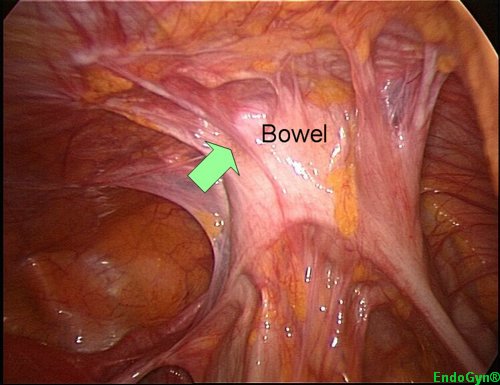
Abdominal adhesions are bands of fibrous scar tissue that form on organs in the abdomen, causing the organs to stick to one another or to the wall of the abdomen. Scar tissue most commonly develops after abdominal surgery, in which organs are handled by the surgical team and are shifted temporarily from their normal positions. It can also form in people who develop peritonitis, an infection that has spread to the membrane that covers the abdominal organs. Vic has developed peritonitis on numerous occasions.  Peritonitis usually occurs after appendicitis or another abdominal infection such as Vic first developed after her blotched surgery when her small bowel was perforated.  https://tersiaburger.com/2012/10/19/the-albatross/

There is no way to prevent adhesions. Abdominal adhesions can be treated, but they can be a recurring problem. Because surgery is both the cause and the treatment, the problem can keep returning. For example, when surgery is done to remove an intestinal obstruction caused by adhesions, adhesions form again and creates a new obstruction in 11% to 21% of cases.  http://www.intelihealth.com/IH/ihtPrint/WSIHW000/9339/9394.html?hide=t&k=basePrint#prognosis

Fibrous Bands of Adhesion – Bowel obstruction

In most patients, adhesions do not cause health problems. In a small number of people, like Vic, the fibrous bands of scar tissue block the intestines either completely or partially. This blockage is called a bowel obstruction, and it leads to death in about 5% of cases. Sometimes, an area of intestine that is affected by adhesions can keep becoming blocked then unblocked, causing symptoms to come and go. In about 10% of small-bowel obstructions, a portion of the bowel twists tightly around a band of adhesions. This cuts off the normal blood supply to the twisted bowel, causing what is called strangulation, and that section of bowel begins to die. When this emergency happens, the person must be taken to surgery immediately. The death rate is as high as 37% in people who develop strangulation.

Literally meters, of different parts of Vic’s intestines, has been removed.  Every time Vic had an obstruction she had surgery.  Vic has needed skin grafts to cover open wounds.  Vic developed numerous gastrointestinal fistulas.  Due to the extremely thin layer of skin covering her intestines the intestines have chaffed through.  Vic would lose up to 7 liters of feces  per day, through the fistula.

Now we cope with partial obstructions on a weekly basis.  We battle with poor absorption because Vic has lost critical parts of her intestines.  Vic will not have further surgery.  My child has been to hell and back.

No more surgery.

Ready for theater….again…..


“Being prepared to die is one of the greatest secrets of living.” George Lincoln Rockwell


26.6.2012 Before Hospice

Pain at the end of life is inescapably interwoven with, and often amplified by, multiple levels of emotional and spiritual angst as the inevitability of death looms. Fear, a potent pain magnifier, is the dominant emotion – fear of pain, fear of death, fear of the unknown…..

It is a fact that people at the end of life fear pain even more than they fear death. Sadly, for many dying patients, pain seems like the ultimate torment, and death is its cure. It does not have to be this way, and if you or a loved one is facing death, you have every right to ask that your final days not be consumed by pain.

It is estimated that a maximum of 5% of people who die from terminal illness in South Africa have access to adequate palliative care. Even in hospitals, treatment is far from ideal, because doctors and nurses have seldom had training in palliative care and have little idea of what to do with the patients.

Dying patients are often prey to a host of anxieties about the state of their affairs, about the fate of those who will grieve their loss, and about how their behaviour will be seen, and possibly judged, during their final hours. And of course, there are often deep spiritual and religious questions to address. Did my life have meaning? Will my soul survive my body? Am I at peace with myself, my family, and my friends?

Not least of all these concerns, people at the end of life worry about how their pain will be managed. Will they be under medicated and have to ask, or even beg for relief? Will they be over-medicated and lose consciousness during their precious waning days and hours?

They may even be afraid to complain. If they do, will they be seen as whiners or quitters? If they ask for narcotics, will they be judged by their doctors as drug seeking, drug addicts or even cowardly? Or will their medical care be relegated to comfort measures only, while all efforts to cure their illness are suspended?

I read the post of an amazing woman who is suffering from congenital heart failure.  She is in so much pain.  I cried when I read her post.  http://thedrsays.org/2012/11/08/  She replied to a question whether better pain control was possible…..  “there is nothing that will let me participate in life and have relief. so at this point i am going for being lucid over some so-so pain relief. who knows how long before i cave. when the time comes i plan to take advantage of whatever is available to me. just my personal choice right now.”

Vic has received a new lease on life.  Vic has 100% better quality of life since her pain is under control. We discovered, through the expertise of a wonderful palliative care team that Vic’s body did not absorb monstrous quantities of morphine! Now she is not only functioning, she is LIVING!  Vic is more lucid than she was before.

The pain was killing Vic… Palliative care has given her life.

Living life to the full!

 Being prepared to die is one of the greatest secrets of living.   George Lincoln Rockwell 


Life is good, life is great!


My beautiful husband and child

The most beautiful man in the world….

I have traveled to 50 odd countries.  I have filled up quite a few passports.  I am a seasoned traveler   I suffer from airport rage.  I hate the “hurry up and wait” part of travelling.  I hate queues and I HATE sitting so close to other people!

I have spent more hours that I care to remember sitting at airports.  I love watching families reunite, lovers melting into one another’s arms, fragile old people being wheeled out in wheelchairs to meet their loved ones.  I recognize the detached “I am on a business trip” air that the professional travelers have surrounding them.

I have spent a lot of time waiting to be collected, or for coaches, buses and trains.  I have seen thousands of loved ones being met with “Welcome” balloons and bouquets of flowers.  I do not have a romantic bone in my body.  I am quite a serious person who loves deeply without conditions or expectations.  I have never been met with flowers or balloons only my name on a hotel ID Board.

This morning when I disembarked the aircraft it was a glorious sunshine day in South Africa.  I was one of the first off the aircraft and went through passport control within minutes.  I could not believe my luck when I got to the carousal and my luggage was already there!  Customs was a breeze.  I walked out of Terminal A and no Danie….  I knew he was minutes away from the airport when we landed because I phoned him to tell him I had landed…. He was minutes away from the airport….

I phoned him and there was no reply….  I phoned him three more times and still no reply.  I shut my mind down.  I did not want to think what could have happened in the 30 minutes since I had last spoken to him.  I phoned him again and left a message….  I kept glancing around.  A couple of taxi drivers started offering their services.

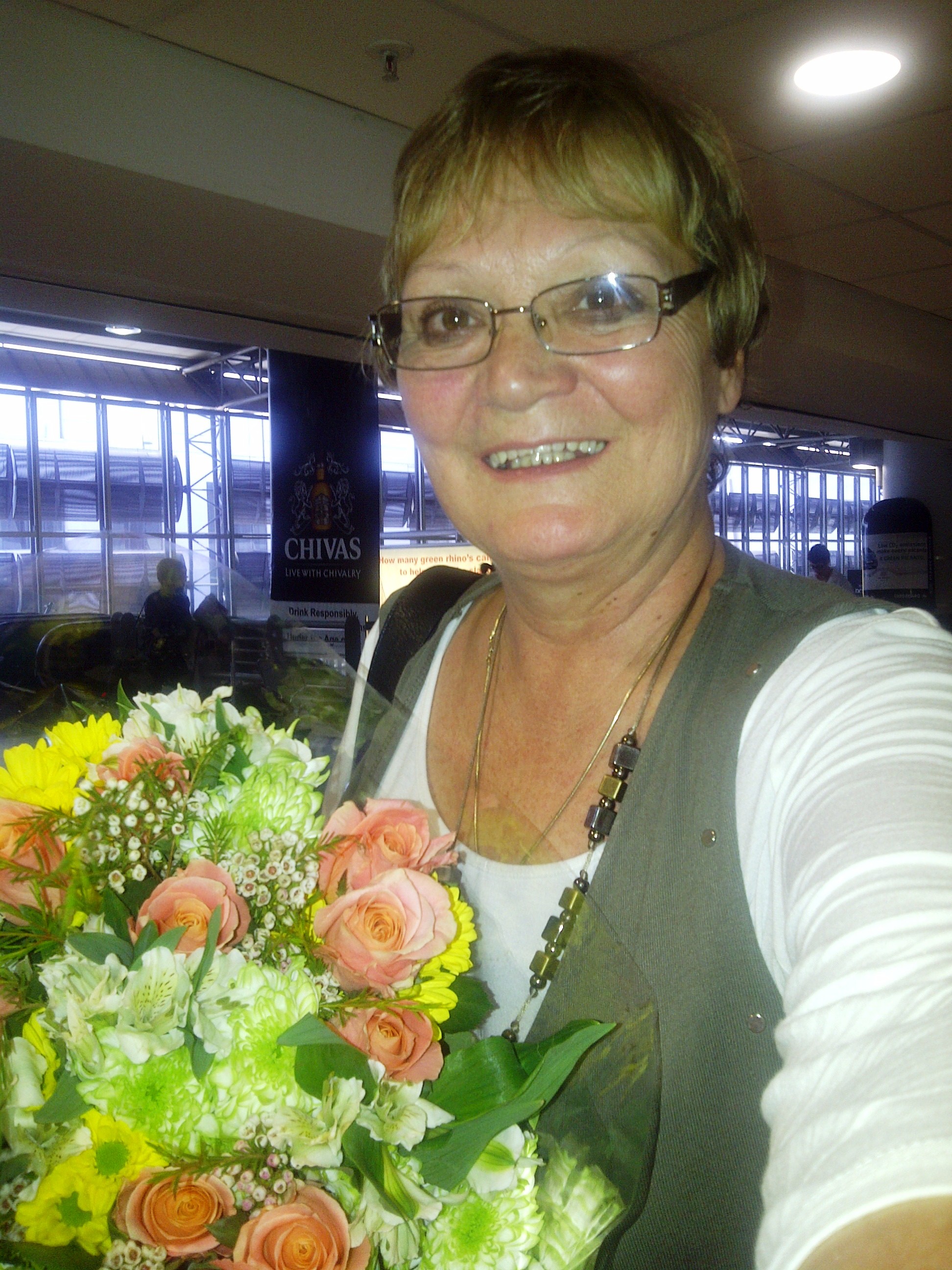
Then I saw him.  My beautiful, handsome husband carrying this huge, beautiful bouquet of flowers!   My unromantic heart was touched by this beautiful gesture.  It was great feeling his arms around him and hearing him say “I really missed you”.

Vic is looking great.  Her pain control is optimal!  She is enjoying the pain free time she has been given by Hospice.  I missed her so much!  I am at peace being home. Image

Despite the fearful trauma and pain of Vic’s journey we are happy as a family!  I cannot imagine going through this painful journey without Danie and his beautiful, wonderful children and our grandchildren.   We are a family of love.

Life is good.  Life is great.